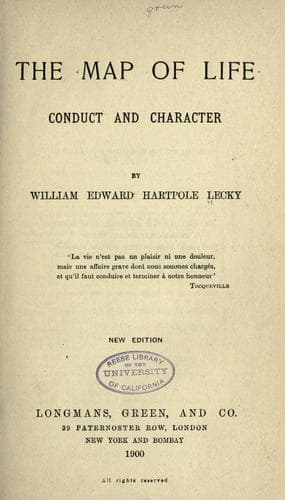
The Map of Life: Conduct and CharacterLecky, William Edward Hartpole
Philosophy
The Map of Life: Conduct and Character
Lecky, William Edward Hartpole
Character; Conduct of life
In the selection of pleasures and the cultivation of tastes much wisdom
is shown in choosing in such a way that each should form a complement to
the others; that different pleasures should not clash, but rather cover
different areas and seasons of life; that each should tend to correct
faults or deficiencies of character which the others may possibly
produce. The young man who starts in life with keen literary tastes and
also with a keen love of out-of-door sports, and who possesses the means
of gratifying each, has perhaps provided himself with as many elements
of happiness as mere amusements can ever furnish. One set of pleasures,
however, often kills the capacity for enjoying others, and some which in
themselves are absolutely innocent, by blunting the enjoyment of better
things, exercise an injurious influence on character. Habitual
novel-reading, for example, often destroys the taste for serious
literature, and few things tend so much to impair a sound literary
perception and to vulgarise the character as the habit of constantly
saturating the mind with inferior literature, even when that literature
is in no degree immoral. Sometimes an opposite evil may be produced.
Excessive fastidiousness greatly limits our enjoyments, and the
inestimable gift of extreme concentration is often dearly bought. The
well-known confession of Darwin that his intense addiction to science
had destroyed his power of enjoying even the noblest imaginative
literature represents a danger to which many men who have achieved much
in the higher and severer forms of scientific thought are subject. Such
men are usually by their original temperament, and become still more by
acquired habit, men of strong, narrow, concentrated natures, whose
thoughts, like a deep and rapid stream confined in a restricted channel,
flow with resistless energy in one direction. It is by the sacrifice of
versatility that they do so much, and the result is amply sufficient to
justify it. But it is a real sacrifice, depriving them of many forms
both of capacity and of enjoyment.
Public-domain text, read in full here on John Shaqi.
Reviews
Reviews
No reviews yet
Be the first to share your thoughts on this work.
Elsewhere in the archive
Join the Discussion
Join the discussion
Sign in to leave a comment or review.
Sign InorCreate an account