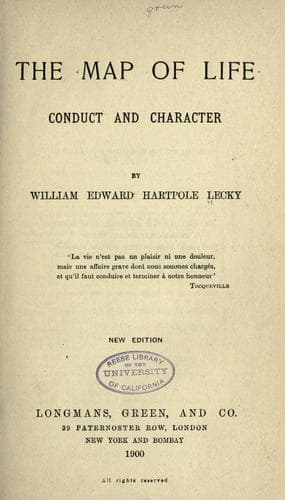
The Map of Life: Conduct and CharacterLecky, William Edward Hartpole
Philosophy
The Map of Life: Conduct and Character
Lecky, William Edward Hartpole
Character; Conduct of life
The best of rest is sleep,
And that thou oft provok'st; yet grossly fear'st
Thy death, which is no more.[78]
To die is landing on some silent shore
Where billows never break, nor tempests roar.[79]
It is a strange thing to observe to what a height not only of moral
excellence, but also of devotional fervour, men have arisen without any
assistance from the doctrine of a future life. Only the faintest and
most dubious glimmer of such a belief can be traced in the Psalms, in
which countless generations of Christians have found the fullest
expression of their devotional feelings, or in the Meditations of Marcus
Aurelius, which are perhaps the purest product of pagan piety.
As I have already said, I am endeavouring in this book to steer clear of
questions of contested theologies; but it is impossible to avoid
noticing the great changes that have been introduced into the conception
of death by some of the teaching which in different forms has grown up
under the name of Christianity, though much of it may be traced in germ
to earlier periods of human development. Death in itself was made
incomparably more terrible by the notion that it was not a law but a
punishment; that sufferings inconceivably greater than those of Earth
awaited the great masses of the human race beyond the grave; that an
event which was believed to have taken place ages before we were born,
or small frailties such as the best of us cannot escape, were sufficient
to bring men under this condemnation; that the only paths to safety were
to be found in ecclesiastical ceremonies; in the assistance of priests;
in an accurate choice among competing theological doctrines. At the same
time the largest and most powerful of the Churches of Christendom has,
during many centuries, done its utmost to intensify the natural fear of
death by associating it in the imaginations of men with loathsome images
and appalling surroundings. There can be no greater contrast than that
between the Greek tomb with its garlands of flowers, its bright,
youthful and restful imagery, and the mortuary chapels that may often be
found in Catholic countries, with their ghastly pictures of the _saved_
souls writhing in purgatorial flames, while the inscription above and
the moneybox below point out the one means of alleviating their lot.
Fermati, O Passagiero, mira tormenti.
Siamo abbandonati dai nostri parenti.
Di noi abbiate pietà, o voi amici cari.
Public-domain text, read in full here on John Shaqi.
Reviews
Reviews
No reviews yet
Be the first to share your thoughts on this work.
Elsewhere in the archive
Join the Discussion
Join the discussion
Sign in to leave a comment or review.
Sign InorCreate an account