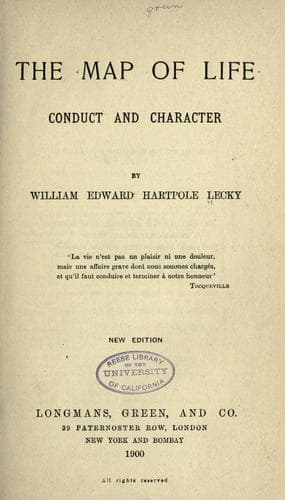
The Map of Life: Conduct and Character — John Shaqi
The Map of Life: Conduct and CharacterLecky, William Edward Hartpole
Philosophy
The Map of Life: Conduct and Character
Lecky, William Edward Hartpole
Character; Conduct of life
It is one of the paradoxes of human nature that the things that are most
struggled for and the things that are most envied are not those which
give either the most intense or the most unmixed joy. Ambition is the
luxury of the happy. It is sometimes, but more rarely, the consolation
and distraction of the wretched; but most of those who have trodden its
paths, if they deal honestly with themselves, will acknowledge that the
gravest disappointments of public life dwindle into insignificance
compared with the poignancy of suffering endured at the deathbed of a
wife or of a child, and that within the small circle of a family life
they have found more real happiness than the applause of nations could
ever give.
Look down, look down from your glittering heights,
And tell us, ye sons of glory,
The joys and the pangs of your eagle flights,
The triumph that crowned the story,
The rapture that thrilled when the goal was won,
The goal of a life's desire;
And a voice replied from the setting sun,
Nay, the dearest and best lies nigher.
How oft in such hours our fond thoughts stray
To the dream of two idle lovers;
To the young wife's kiss; to the child at play;
Or the grave which the long grass covers!
And little we'd reck of power or gold,
And of all life's vain endeavour,
If the heart could glow as it glowed of old,
And if youth could abide for ever.
Another consideration in the cultivation of happiness is the importance
of acquiring the habit of realising our blessings while they last. It is
one of the saddest facts of human nature that we commonly only learn
their value by their loss. This, as I have already noticed, is very
evidently the case with health. By the laws of our being we are almost
unconscious of the action of our bodily organs as long as they are
working well. It is only when they are deranged, obstructed or impaired
that our attention becomes concentrated upon them. In consequence of
this a state of perfect health is rarely fully appreciated until it is
lost and during a short period after it has been regained. Gray has
described the new sensation of pleasure which convalescence gives in
well-known lines:
See the wretch who long has tost
On the thorny bed of pain,
At length repair his vigour lost
And breathe and walk again;
The meanest floweret of the vale,
The simplest note that swells the gale,
The common sun, the air, the skies,
To him are opening Paradise.
Public-domain text, read in full here on John Shaqi.
Reviews
Reviews
No reviews yet
Be the first to share your thoughts on this work.
Join the Discussion
Join the discussion
Sign in to leave a comment or review.
Sign InorCreate an account