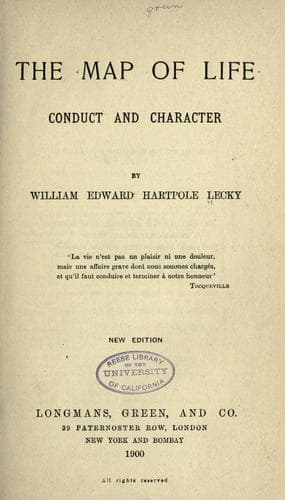
The Map of Life: Conduct and CharacterLecky, William Edward Hartpole
Philosophy
The Map of Life: Conduct and Character
Lecky, William Edward Hartpole
Character; Conduct of life
And what is true of health is true of other things. It is only when some
calamity breaks the calm tenor of our ways and deprives us of some gift
of fortune we have long enjoyed that we feel how great was the value of
what we have lost. There are times in the lives of most of us when we
would have given all the world to be as we were but yesterday, though
that yesterday had passed over us unappreciated and unenjoyed.
Sometimes, indeed, our perception of this contrast brings with it a
lasting and salutary result. In the medicine of Nature a chronic and
abiding disquietude or morbidness of temperament is often cured by some
keen though more transient sorrow which violently changes the current of
our thoughts and imaginations.
The difference between knowledge and realisation is one of the facts of
our nature that are most worthy of our attention. Every human mind
contains great masses of inert, passive, undisputed knowledge which
exercise no real influence on thought or character till something occurs
which touches our imagination and quickens this knowledge into
activity. Very few things contribute so much to the happiness of life as
a constant realisation of the blessings we enjoy. The difference between
a naturally contented and a naturally discontented nature is one of the
marked differences of innate temperament, but we can do much to
cultivate that habit of dwelling on the benefits of our lot which
converts acquiescence into a more positive enjoyment. Religion in this
field does much, for it inculcates thanksgiving as well as prayer,
gratitude for the present and the past as well as hope for the future.
Among secular influences, contrast and comparison have the greatest
value. Some minds are always looking on the fortunes that are above them
and comparing their own penury with the opulence of others. A wise
nature will take an opposite course and will cultivate the habit of
looking rather at the round of the ladder of fortune which is below our
own and realising the countless points in which our lot is better than
that of others. As Dr. Johnson says, 'Few are placed in a situation so
gloomy and distressful as not to see every day beings yet more forlorn
and miserable from whom they may learn to rejoice in their own lot.'
Public-domain text, read in full here on John Shaqi.
Reviews
Reviews
No reviews yet
Be the first to share your thoughts on this work.
Join the Discussion
Join the discussion
Sign in to leave a comment or review.
Sign InorCreate an account