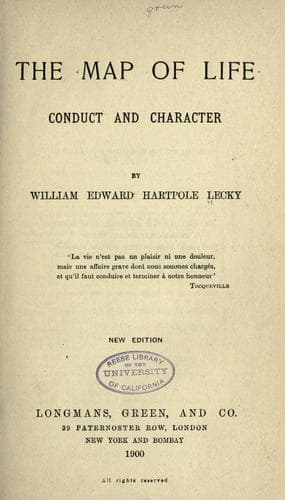
The Map of Life: Conduct and Character — John Shaqi
The Map of Life: Conduct and CharacterLecky, William Edward Hartpole
Philosophy
The Map of Life: Conduct and Character
Lecky, William Edward Hartpole
Character; Conduct of life
This is, I believe, on the whole true, but it is also true that there
are grave diseases which attach themselves peculiarly to the unselfish
side of our nature, and they are peculiarly dangerous because men,
feeling that the unselfish is the virtuous and nobler side of their
being, are apt to suffer these tendencies to operate without supervision
or control. Yet it is hardly possible to exaggerate the calamities that
have sprung from misjudged unselfish actions. The whole history of
religious persecution abundantly illustrates it, for there can be
little question that a large proportion of the persecutors were
sincerely seeking what they believed to be the highest good of mankind.
And if this dark page of human history is now almost closed, there are
still many other ways in which a similar evil is displayed. Crotchets,
sentimentalities and fanaticisms cluster especially around the unselfish
side of our nature, and they work evil in many curious and subtle ways.
Few things have done more harm in the world than disproportioned
compassion. It is a law of our being that we are only deeply moved by
sufferings we distinctly realise, and the degrees in which different
kinds of suffering appeal to the imagination bear no proportion to their
real magnitude. The most benevolent man will read of an earthquake in
Japan or a plague in South America with a callousness he would never
display towards some untimely death or some painful accident in his
immediate neighbourhood, and in general the suffering of a prominent and
isolated individual strikes us much more forcibly than that of an
undistinguished multitude. Few deaths are so prominent, and therefore
few produce such widespread compassion, as those of conspicuous
criminals. It is no exaggeration to say that the death of an
'interesting' murderer will often arouse much stronger feelings than
were ever excited by the death of his victim; or by the deaths of brave
soldiers who perished by disease or by the sword in some obscure
expedition in a remote country. This mode of judgment acts promptly upon
conduct. The humanitarian spirit which mitigates the penal code and
makes the reclamation of the criminal a main object is a perfectly
right thing as long as it does not so far diminish the deterrent power
of punishment as to increase crime, and as long as it does not place the
criminal in a better position of comfort than the blameless poor, but
when these conditions are not fulfilled it is much more an evil than a
good. The remote, indirect and unrealised consequences of our acts are
often far more important than those which are manifest and direct, and
it continually happens that in extirpating some concentrated and
obtrusive evil, men increase or engender a diffused malady which
operates over a far wider area. How few, for example, who share the
prevailing tendency to deal with every evil that appears in Society by
coercive legislation adequately realise the danger of weakening the
Public-domain text, read in full here on John Shaqi.
Reviews
Reviews
No reviews yet
Be the first to share your thoughts on this work.
Join the Discussion
Join the discussion
Sign in to leave a comment or review.
Sign InorCreate an account