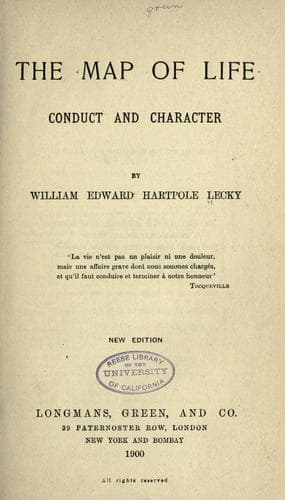
The Map of Life: Conduct and CharacterLecky, William Edward Hartpole
Philosophy
The Map of Life: Conduct and Character
Lecky, William Edward Hartpole
Character; Conduct of life
robust, self-reliant, resourceful habits on which the happiness of
Society so largely depends, and at the same time, by multiplying the
functions and therefore increasing the expenses of government, throwing
new and crushing burdens on struggling industry! How often have
philanthropists, through a genuine interest for some suffering class or
people, advocated measures which by kindling, prolonging, or enlarging a
great war would infallibly create calamities far greater than those
which they would redress! How often might great outbursts of savage
crime or grave and lasting disorders in the State, or international
conflicts that have cost thousands of lives, have been averted by a
prompt and unflinching severity from which an ill-judged humanity
recoiled! If in the February of 1848 Louis Philippe had permitted
Marshal Bugeaud to fire on the Revolutionary mob at a time when there
was no real and widespread desire for revolution in France, how many
bloody pages of French and European history might have been spared!
Measures guaranteeing men, and still more women, from excessive labour,
and surrounding them with costly sanitary precautions, may easily, if
they are injudiciously framed, so handicap a sex or a people in the
competition of industry as to drive them out of great fields of
industry, restrict their means of livelihood, lower their standard of
wages and comfort, and thus seriously diminish the happiness of their
lives. Injudicious suppressions of amusements that are not wholly good,
but which afford keen enjoyment to great masses, seldom fail to give an
impulse to other pleasures more secret and probably more vicious.
Injudicious charities, or an extravagant and too indulgent poor law
administration, inevitably discourage industry and thrift, and usually
increase the poverty they were intended to cure. The parent who shrinks
from inflicting any suffering on his child, or withholding from him any
pleasure that he desires, is not laying the foundation of a happy life,
and the benevolence which counteracts or obscures the law of nature that
extravagance, improvidence and vice lead naturally to ruin, is no real
kindness either to the upright man who has resisted temptation or to the
weak man whose virtue is trembling doubtfully in the balance. Nor is it
in the long run for the benefit of the world that superior ability or
superior energy or industry should be handicapped in the race of life,
forbidden to encounter exceptional risks for the sake of exceptional
rewards, reduced by regulations to measures of work and gain intended
for the benefit of inferior characters or powers.
Public-domain text, read in full here on John Shaqi.
Reviews
Reviews
No reviews yet
Be the first to share your thoughts on this work.
Join the Discussion
Join the discussion
Sign in to leave a comment or review.
Sign InorCreate an account