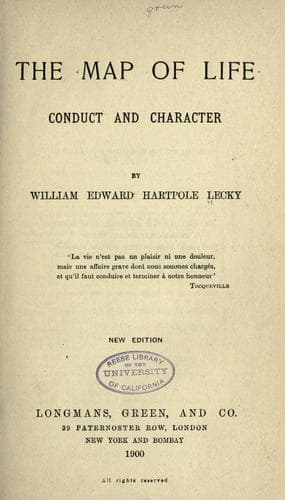
The Map of Life: Conduct and CharacterLecky, William Edward Hartpole
Philosophy
The Map of Life: Conduct and Character
Lecky, William Edward Hartpole
Character; Conduct of life
The illustrations given in the last chapter will be sufficient to show
the danger of permitting the unselfish side of human nature to run wild
without serious control by the reason and by the will. To see things in
their true proportion, to escape the magnifying influence of a morbid
imagination, should be one of the chief aims of life, and in no fields
is it more needed than in those we have been reviewing. At the same time
every age has its own ideal moral type towards which the strongest and
best influences of the time converge. The history of morals is
essentially a history of the changes that take place not so much in our
conception of what is right and wrong as in the proportionate place and
prominence we assign to different virtues and vices. There are large
groups of moral qualities which in some ages of the world's history have
been regarded as of supreme importance, while in other ages they are
thrown into the background, and there are corresponding groups of vices
which are treated in some periods as very serious and in others as very
trivial. The heroic type of Paganism and the saintly type of
Christianity in its purest form, consist largely of the same elements,
but the proportions in which they are mixed are altogether different.
There are ages when the military and civic virtues--the qualities that
make good soldiers and patriotic citizens--dominate over all others. The
self-sacrifice of the best men flows habitually in these channels. In
such an age integrity in business relations and the domestic virtues
which maintain the purity of the family may be highly valued, but they
are chiefly valued because they are essential to the well-being of the
State. The soldier who has attained to the highest degree the best
qualities of his profession, the patriot who sacrifices to the services
of the State his comforts, his ambitions and his life, is the supreme
model, and the estimation in which he is held is but little lowered even
though he may have been guilty, like Cato, of atrocious cruelty to his
slaves, or, like some of the heroes of ancient times, of scandalous
forms of private profligacy.
Public-domain text, read in full here on John Shaqi.
Reviews
Reviews
No reviews yet
Be the first to share your thoughts on this work.
Join the Discussion
Join the discussion
Sign in to leave a comment or review.
Sign InorCreate an account