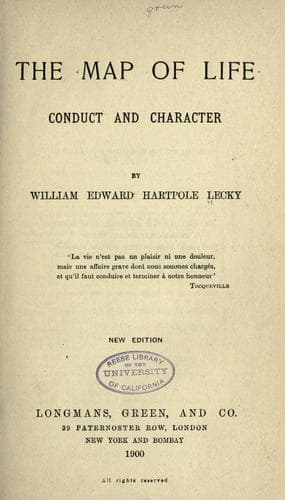
The Map of Life: Conduct and CharacterLecky, William Edward Hartpole
Philosophy
The Map of Life: Conduct and Character
Lecky, William Edward Hartpole
Character; Conduct of life
The cases in which a member of Parliament finds it his duty to support a
measure which he believes to be positively bad, on the ground that
greater evils would follow its rejection, are happily not very numerous.
He can extricate himself from many moral difficulties by sometimes
abstaining from voting or from the expression of his real opinions, and
most measures are of a composite character in which good and evil
elements combine, and may in some degree be separated. In such measures
it is often possible to accept the general principle while opposing
particular details, and there is considerable scope for compromise and
modification. But the cases in which a member of Parliament is compelled
to vote for measures about which he has no real knowledge or conviction
are very many. Crowds of measures of a highly complex and technical
character, affecting departments of life with which he has had no
experience, relating to the multitudinous industries, interests and
conditions of a great people, are brought before him at very short
notice; and no intellect, however powerful, no industry, however great,
can master them. It is utterly impossible that mere extemporised
knowledge, the listening to a short debate, the brief study which a
member of Parliament can give to a new subject, can place him on a real
level of competence with those who can bring to it a lifelong knowledge
or experience.
A member of Parliament will soon find that he must select a class of
subjects which he can himself master, while on many others he must vote
blindly with his party. The two or three capital measures in a session
are debated with such a fulness that both the House and the country
become thoroughly competent to judge them, and in those cases the
preponderance of argument will have great weight. A powerful ministry
and a strongly organised party may carry such a measure in spite of it,
but they will be obliged to accept amendments and modifications, and if
they persist in their policy their position both in the House and in the
country will sooner or later be inevitably changed. But a large number
of measures have a more restricted interest, and are far less widely
understood. The House of Commons is rich in expert knowledge, and few
subjects are brought before it which some of its members do not
thoroughly understand; but in a vast number of cases the majority who
decide the question are obliged to do so on the most superficial
knowledge. Very often it is physically impossible for a member to obtain
the knowledge he requires. The most important and detailed investigation
has taken place in a committee upstairs to which he did not belong, or
he is detained elsewhere on important parliamentary business while the
debate is going on. Even when this is not the case, scarcely any one
has the physical or mental power which would enable him to sit
intelligently through all the debates. Every member of Parliament is
Public-domain text, read in full here on John Shaqi.
Reviews
Reviews
No reviews yet
Be the first to share your thoughts on this work.
Elsewhere in the archive
Join the Discussion
Join the discussion
Sign in to leave a comment or review.
Sign InorCreate an account