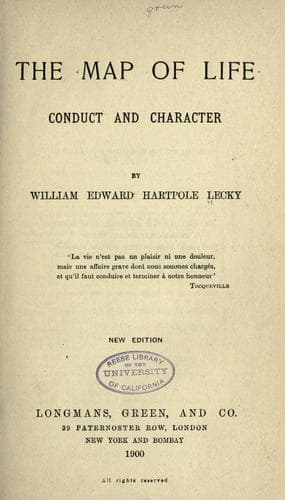
The Map of Life: Conduct and CharacterLecky, William Edward Hartpole
Philosophy
The Map of Life: Conduct and Character
Lecky, William Edward Hartpole
Character; Conduct of life
familiar with the scene, when, after a debate, carried on before nearly
empty benches, the division bell rings, and the members stream in to
decide the issue. There is a moment of uncertainty. The questions 'Which
side are we?' 'What is it about?' may be heard again and again. Then the
Speaker rises, and with one magical sentence clears the situation. It is
the sentence in which he announces that the tellers for the Ayes or
Noes, as the case may be, are the Government whips. It is not argument,
it is not eloquence, it is this single sentence which in countless cases
determines the result and moulds the legislation of the country. Many
members, it is true, are not present in the division lobby, but they are
usually paired--that is to say, they have taken their sides before the
discussion began; perhaps without even knowing what subject is to be
discussed, perhaps for all the many foreseen and unforeseen questions
that may arise during long periods of the session.
It is a strange process, and to a new member who has been endeavouring
through his life to weigh arguments and evidence with scrupulous care,
and treat the formation and expression of opinions as a matter of
serious duty, it is at first very painful. He finds that he is required
again and again to give an effective voice in the great council of the
nation, on questions of grave importance, with a levity of conviction
upon which he would not act in the most trivial affairs of private life.
No doctor would prescribe for the slightest malady; no lawyer would
advise in the easiest case; no wise man would act in the simplest
transactions of private business, or would even give an opinion to his
neighbour at a dinner party without more knowledge of the subject than
that on which a member of Parliament is often obliged to vote. But he
soon finds that for good or evil this system is absolutely indispensable
to the working of the machine. If no one voted except on matters he
really understood and cared for, four-fifths of the questions that are
determined by the House of Commons would be determined by mere fractions
of its members, and in that case parliamentary government under the
party system would be impossible. The stable, disciplined majorities
without which it can never be efficiently conducted would be at an end.
Those who refuse to accept the conditions of parliamentary life should
abstain from entering into it.
Public-domain text, read in full here on John Shaqi.
Reviews
Reviews
No reviews yet
Be the first to share your thoughts on this work.
Elsewhere in the archive
Join the Discussion
Join the discussion
Sign in to leave a comment or review.
Sign InorCreate an account