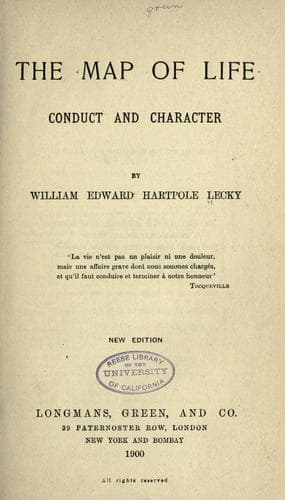
The Map of Life: Conduct and CharacterLecky, William Edward Hartpole
Philosophy
The Map of Life: Conduct and Character
Lecky, William Edward Hartpole
Character; Conduct of life
It is obvious that the one justification of this system is to be found
in the belief that parliamentary government, as it is worked in England,
is on the whole a good thing, and that this is the indispensable
condition of its existence. Probably also with most men it strengthens
the disposition to support the Government on matters which they do not
understand and in which grave party issues are not involved. They know
that these minor questions have at least been carefully examined on
their merits by responsible men, and with the assistance of the best
available expert knowledge.
This fact goes far to reconcile us to the tendency to give governments
an almost complete monopoly in the initiation of legislation which is so
evident in modern parliamentary life. Much useful legislation in the
past has been due to private and independent members, but the chance of
bills introduced by such members ever becoming law is steadily
diminishing. This is not due to any recognised constitutional change,
but to the constantly increasing pressure of government business on the
time of the House, and especially to what is called the twelve o'clock
rule, terminating debates at midnight.
It is a rule which is manifestly wise, for it limits on ordinary
occasions the hours of parliamentary work to a period within the
strength of an average man. Parliamentary government has many dubious
aspects, but it never appears worse than in the cases which may still
sometimes be seen when a Government thinks fit to force through an
important measure by all-night sittings, and when a weary and irritated
House which has been sitting since three or four in the afternoon is
called upon at a corresponding hour of the early morning to pronounce
upon grave and difficult questions of principle, and to deal with the
serious interests of large classes. The utter and most natural
incapacity of the House at such an hour for sustained argument; its
anxiety that each successive amendment should be despatched in five
minutes; the readiness with which in that tired, feverish atmosphere,
surprises and coalitions may be effected and solutions accepted, to
which the House in its normal state would scarcely have listened, must
be evident to every observer. Scenes of this kind are among the greatest
scandals of Parliament, and the rule which makes them impossible except
in the closing weeks of the Session has been one of the greatest
improvements in modern parliamentary work. But its drawback is that it
has greatly limited the possibility of private member legislation. It is
in late and rapid sittings that most measures of this kind passed
through their final stages, and since the twelve o'clock rule has been
adopted a much smaller number of bills introduced by private members
find their way to the statute book.
FOOTNOTES:
[35] O'Brien, _The Lawyer_, pp. 169, 170.
[36] _Dictionnaire de Cas de Conscience_, Art. 'Avocat;' Migne,
_Encyclopédie Théologique_, i. serie, tome xviii.
Public-domain text, read in full here on John Shaqi.
Reviews
Reviews
No reviews yet
Be the first to share your thoughts on this work.
Elsewhere in the archive
Join the Discussion
Join the discussion
Sign in to leave a comment or review.
Sign InorCreate an account