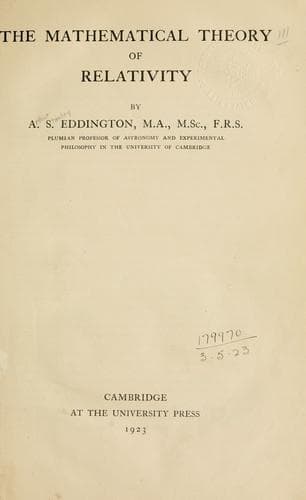
The Mathematical Theory of RelativityEddington, Arthur Stanley, Sir
Science
The Mathematical Theory of Relativity
Eddington, Arthur Stanley, Sir
Relativity (Physics)
The isotropic system could have been found directly by seeking particular
solutions of Einstein's equations having the form~\Eq{(38.12)}, or
\[
ds^{2} = -e^{\lambda}\, dr^{2} - e^{\mu}(r^{2}\, d\theta^{2} + r^{2}\sin^{2}\theta\, d\phi^{2}) + e^{\nu}\, dt^{2},
\]
where $\lambda$, $\mu$, $\nu$ are functions of~$r$. By the method of \SecRef{38}, we find
\[
\left.
\begin{aligned}
G_{11} &= \mu'' + \tfrac{1}{2}\nu'' + \frac{2}{r}\mu' - \frac{1}{r}\lambda' + \tfrac{1}{2}\mu'^{2} - \tfrac{1}{2}\lambda'\mu' - \tfrac{1}{4}\lambda'\nu' + \tfrac{1}{4}\nu'^{2}\Add{,} \\
G_{22} &= e^{\mu-\lambda} \bigl[1 + 2r\mu' + \tfrac{1}{2}r(\nu' - \lambda') + \tfrac{1}{2}r^{2}\mu'' \\
&\qquad\qquad+ \tfrac{1}{2}r^{2}\mu'(\mu' + \tfrac{1}{2}\nu' - \tfrac{1}{2}\lambda')\bigr] - 1\Add{,} \\
G_{33} &= G_{22} \sin^{2}\theta\Add{,} \\
G_{44} &= -e^{\nu-\lambda}\left[\tfrac{1}{2}\nu'' + \frac{1}{r}\nu' + \tfrac{1}{2}\nu'\mu' - \tfrac{1}{4}\lambda'\nu' + \tfrac{1}{4}\nu'^{2}\right]\Add{.}
\end{aligned}
\right\}
\Tag{(43.5)}
\]
The others are zero.
Owing to an identical relation between $G_{11}$, $G_{22}$ and~$G_{44}$, the vanishing of
this tensor gives only two equations to determine the three unknowns $\lambda$, $\mu$,~$\nu$.
There exists therefore an infinite series of particular solutions, differing
according to the third equation between $\lambda$, $\mu$, $\nu$ which is at our disposal. The
two solutions hitherto considered are obtained by taking $\mu = 0$, and $\lambda = \mu$,
respectively. The same series of solutions is obtained in a simpler way by
substituting arbitrary functions of~$r$ instead of~$r$ in~\Eq{(38.8)}.
\PageSep{95}
The possibility of substituting any function of~$r$ for~$r$ without destroying
the spherical symmetry is obvious from the fact that a coordinate is merely
an identification-number; but analytically this possibility is bound up with
the existence of an identical relation between $G_{11}$, $G_{22}$ and~$G_{44}$, which makes
the equations too few to determine a unique solution.
This introduces us to a theorem of great consequence in our later work.
\index{Identities satisfied by $G_{\mu\nu}$}%
If Einstein's ten equations $G_{\mu\nu} = 0$ were all independent, the ten~$g_{\mu\nu}$ would be
uniquely determined by them (the boundary conditions being specified). The
expression for~$ds^{2}$ would be unique and no transformation of coordinates would
be possible. Since we know that we can transform coordinates as we please,
there must exist identical relations between the ten~$G_{\mu\nu}$; and these will be
found in \SecRef{52}.
\Section{44.}{Problem of two bodies---Motion of the moon}
\index{Moon, motion of}%
\index{Problem!of two bodies}%
\index{Two bodies, problem of}%
Public-domain text, read in full here on John Shaqi.
Reviews
Reviews
No reviews yet
Be the first to share your thoughts on this work.
Elsewhere in the archive
Join the Discussion
Join the discussion
Sign in to leave a comment or review.
Sign InorCreate an account