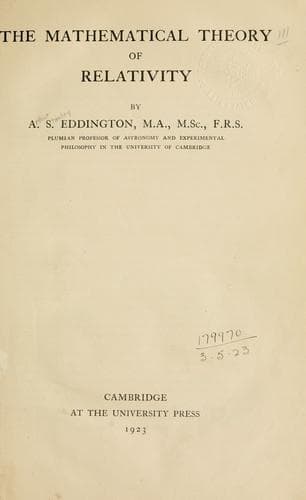
The Mathematical Theory of RelativityEddington, Arthur Stanley, Sir
Science
The Mathematical Theory of Relativity
Eddington, Arthur Stanley, Sir
Relativity (Physics)
We may put to the experiments three questions in \Foreign{crescendo}. Do they
\index{Deductive theory and experiment}%
\index{Experiment and deductive theory}%
\index{Inductive theory}%
verify? Do they suggest? Do they (within certain limitations) compel the
laws we adopt? It is when the last question is put that the difficulty arises
for there are always limitations which will embarrass the mathematician who
wishes to keep strictly to rigorous inference. What, for example, does experiment
enable us to assert with regard to the gravitational field of a particle
(the other four postulates being granted)? Firstly, we are probably justified
in assuming that the interval can be expressed in the form~\Eq{(38.2)}, and experiment
shows that $\lambda$~and $\nu$ tend to zero at great distances. Provided that $e^{\lambda}$ and
$e^{\nu}$ are simple functions it will be possible to expand the coefficients in the form
%[** TN: Not broken in the original]
\begin{multline*}
ds^{2} = -\biggl(1 + \frac{a_{1}}{r} + \frac{a_{2}}{r^{2}} + \cdots\biggr)^{-1} dr^{2}
- r^{2}\, d\theta^{2} - r^{2}\sin^{2}\theta\, d\phi^{2} \\
+ \biggl(1 + \frac{b_{1}}{r} + \frac{b_{2}}{r^{2}} + \frac{b_{3}}{r^{3}} + \cdots\biggr)^{-1} dt^{2}.
\end{multline*}
Now reference to \SecRefs{39}, \SecNum{40}, \SecNum{41} enables us to decide the following points: \\
\Indent (1) The Newtonian law of gravitation shows that $b_{1} = -2m$. \\
\Indent (2) The observed deflection of light then shows that $a_{1} = -2m$. \\
\Indent (3) The motion of perihelion of Mercury then shows that $b_{2} = 0$. \\
The last two coefficients are not determined experimentally with any high
accuracy; and we have no experimental knowledge of the higher coefficients.
If the higher coefficients are zero we can proceed to deduce that this field
satisfies $G_{\mu\nu} = 0$.
If small concessions are made, the case for the law $G_{\mu\nu} = 0$ can be
strengthened. Thus if only one linear constant~$m$ is involved in the specification
of the field, $b_{2}$~must contain~$m^{3}$, and the corresponding term is of order~$(m/r)^{3}$,
an extremely small quantity. Whatever the higher coefficients may
be, $G_{\mu\nu}$~will then vanish to a very high order of approximation.
Turning to the other object of our inquiry, we have yet to explain how
these five laws originate in the structure of the world. In the next chapter
we shall be concerned mainly with Nos.~3 and~5, which are not independent
\PageSep{106}
of one another. They will be replaced by a broader principle which contains
them both and is of a more axiomatic character. No.~4 will be traced to its
origin in the electromagnetic theory of Chapter~\ChapNum{VI}\@. Finally a synthesis of
these together with Nos.~1 and~2 will be attempted in the closing chapter.
The following forward references will enable the reader to trace exactly
what becomes of these postulates in the subsequent advance towards more
primitive conceptions:
Public-domain text, read in full here on John Shaqi.
Reviews
Reviews
No reviews yet
Be the first to share your thoughts on this work.
Elsewhere in the archive
Join the Discussion
Join the discussion
Sign in to leave a comment or review.
Sign InorCreate an account