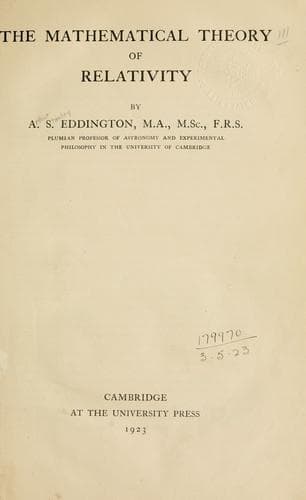
The Mathematical Theory of RelativityEddington, Arthur Stanley, Sir
Science
The Mathematical Theory of Relativity
Eddington, Arthur Stanley, Sir
Relativity (Physics)
The spectroscopic radial velocity is not exactly equivalent to~$dr/dt$, but
\index{Light-pulse!in curved world}%
the divergence is unimportant. A pulse of light emitted by an atom situated
at $r = R\sin\chi$ at time~$t$ will reach the observer at the origin at time~$t'$, where
by~\Eq{(67.5)}
\[
t' = t + \log\tan(\tfrac{1}{4}\pi + \tfrac{1}{2}\chi),
\]
so that for the time-interval between two pulses
\begin{align*}
dt' &= dt + \sec\chi\, d\chi \\
&= \left(1 + \sec\chi\, \frac{d\chi}{dt}\right) \frac{dt}{ds}\, ds \\
&= \left(\sec\chi + \sec^{2}\chi\, \frac{d\chi}{dt}\right) ds,
\quad\text{by~\Eq{(67.33)}}
\end{align*}
\PageSep{164}
\index{Atom, time of vibration of!in de Sitter's world}%
neglecting the square of the velocity of the atom. If $dt_{0}'$~is the time for a
similar atom at rest at the origin,
\begin{align*}
\frac{dt'}{dt_{0}'}
&= \sec\chi + \sec^{2}\chi\, \frac{d\chi}{dt} \\
&= \sec\chi + \sec^{2}\chi\, \frac{1}{R}\, \frac{dr}{dt}.
\Tag{(70.4)}
\end{align*}
The first term represents the general shift to the red dependent on position
and not on velocity. Assuming that it has been allowed for, the remaining
part of the shift corresponds to a velocity of $\smash[b]{\sec^{3}\chi\, \dfrac{dr}{dt}}$ instead of~$\dfrac{dr}{dt}$. The
correction is scarcely of practical importance.
The acceleration $\frac{1}{3}\lambda r$ found in~\Eq{(70.22)}, if continued for the time~$R\chi$ taken
by the light from the object to reach the origin, would cause a change of
velocity of the order $\frac{1}{3}\lambda r^{2}$ or~$r^{2}/R^{2}$. The Doppler effect of this velocity would
be roughly the same as the shift to the red caused by the slowing down of
atomic vibrations. We may thus regard the red shift for distant objects at
rest as \emph{an anticipation} of the motion of recession which will have been attained
before we receive the light. If de~Sitter's interpretation of the red shift in
the spiral nebulae is correct, we need not regard the deduced large motions
of recession as entirely fallacious; it is true that the nebulae had not these
motions when they emitted the light which is now examined, but they have
acquired them by now. Even the standing still of time on the horizon becomes
intelligible from this point of view; we are supposed to be observing a system
which has \emph{now} the velocity of light, having acquired it during the infinite
time which has elapsed since the observed light was emitted.
Public-domain text, read in full here on John Shaqi.
Reviews
Reviews
No reviews yet
Be the first to share your thoughts on this work.
Elsewhere in the archive
Join the Discussion
Join the discussion
Sign in to leave a comment or review.
Sign InorCreate an account