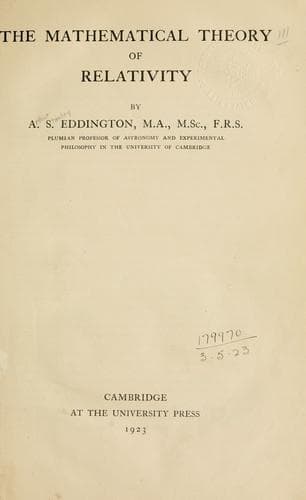
The Mathematical Theory of RelativityEddington, Arthur Stanley, Sir
Science
The Mathematical Theory of Relativity
Eddington, Arthur Stanley, Sir
Relativity (Physics)
A solution of~\Eq{(74.51)}, giving plane waves, is
\index{Propagation with unit velocity!solution of equation}%
\index{Wave-equation, solution of}%
\[
\kappa_{\mu} = A_{\mu} \exp\frac{2\pi i}{\lambda}(lx + my + nz - ct).
\Tag{(74.53)}
\]
Here $A_{\mu}$~is a constant vector; $l$, $m$, $n$ are direction cosines so that $l^{2} + m^{2} + n^{2} = 1$.
Substituting in~\Eq{(74.51)} we find that it will be satisfied if $c^{2} = 1$ and the first
and second derivatives of $l$, $m$, $n$, $c$ vanish. According to the usual discussion
of this equation $(l, m, n)$ is the direction of the ray and $c$~the velocity of
propagation along the ray.
The vanishing of first and second derivatives of $(l, m, n)$ shows that the
direction of the ray is stationary at the point considered. (The light-oscillations
correspond to~$F_{\mu\nu}$ (not~$\kappa_{\mu}$) and the direction of the ray would not
necessarily agree with $(l, m, n)$ if the first derivatives did not vanish; consequently
the stationary property depends on the vanishing of second derivatives
as well.) Further the velocity~$c$ along the ray is unity.
It follows that in any kind of space-time the ray is a geodesic, and the
velocity is such as to satisfy the equation $ds = 0$. Stated in this form, the
result deduced for a very special system of coordinates must hold for all
coordinate-systems since it is expressed invariantly. The expression for the
potential~\Eq{(74.53)} is, of course, only valid for the special coordinate-system.
We have thus arrived at a justification of the law for the track of a light-pulse
(\SecRef{47}~(4)) which has been adopted in our previous work.
\Subsection[(d)]{Solution of the equation $\Wave\kappa^{\mu} = J^{\mu}$.}
We assume that space-time is flat to the order of approximation required,
and accordingly adopt Galilean coordinates. The equation becomes
\[
\frac{\dd^{2}\kappa^{\mu}}{\dd t^{2}} - \nabla^{2}\kappa^{\mu} = J^{\mu},
\]
of which the solution (well known in the theory of sound) is
\[
\{\kappa^{\mu}\}_{x,y,z,t} = \frac{1}{4\pi} \iiint \{J^{\mu}\}_{\xi,\eta,\zeta,t-r} · \frac{d\xi\, d\eta\, d\zeta}{r},
\Tag{(74.61)}
\]
where $r$~is the distance between $(x, y, z)$ and $(\xi,\eta, \zeta)$.
The contributions to~$\kappa^{\mu}$ of each element of charge or current are simply
additive; accordingly we shall consider a single element of charge~$de$ moving
with velocity~$A^{\mu}$, and determine the part of~$\kappa^{\mu}$ corresponding to it. By~\Eq{(73.81)}
the equation becomes
\[
\kappa^{\mu} = \frac{1}{4\pi}\, \frac{ds}{dt} A^{\mu} \iiint \rho\, \frac{d\xi\, d\eta\, d\zeta}{r},
\Tag{(74.62)}
\]
where all quantities on the right are taken for the time~$t - r$.
Public-domain text, read in full here on John Shaqi.
Reviews
Reviews
No reviews yet
Be the first to share your thoughts on this work.
Elsewhere in the archive
Join the Discussion
Join the discussion
Sign in to leave a comment or review.
Sign InorCreate an account