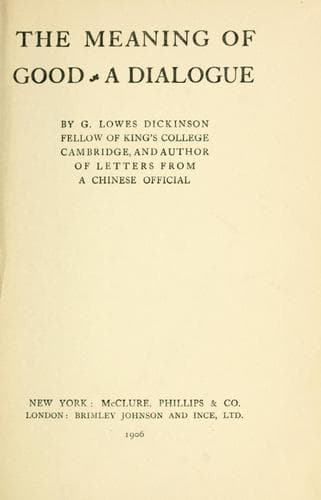
The Meaning of Good—A DialogueDickinson, G. Lowes (Goldsworthy Lowes)
Philosophy
The Meaning of Good—A Dialogue
Dickinson, G. Lowes (Goldsworthy Lowes)
Good and evil
"I think," he replied, "that I mean two things, both of which must be
present. First, that there shall be a necessary connection among the
elements presented; and secondly, that the elements themselves should
be of such a kind as to be, as it were, transparent to that which
apprehends them, so that it asks no questions as to what they are
or whence they come, but accepts them naturally and as a matter of
course, with the same inevitability as it accepts its own being."
"And these conditions, you think, are fulfilled by the objects of
thought as you defined them?
"I think so."
"I am not so sure of that," I said, "it would require a long
discussion. But, anyhow, you also seemed to admit, when Ellis pressed
you, that thought of that kind could hardly be identified absolutely
with Good."
"I admit," he replied, "that there are difficulties in that view."
"But at the same time the Good, whatever it be, ought to be
intelligible in the sense you have explained?"
"I should say so."
"And so should I. But now, the question is, can we not conceive of
any other kind of object, which might have, on the one hand, the
intelligibility you ascribe to pure ideas, and on the other, that
immediate something, 'luscious and aplomb,' to borrow Ellis's
quotation, which he desiderated as a constituent of the Good?"
"I don't know," he said, "perhaps we might. What is it you have in
your mind?"
"Well," I replied, "let us recur for a moment to works of art. In them
we have, to begin with, directly presented elements other than mere
ideas."
"No doubt."
"And further, these elements, we agreed, have a necessary connection
one with the other."
"Yes, but not logically necessary."
"No doubt, but still a necessary connection. And it is the necessity
of the connection, surely, that is important; the character of the
necessity is a secondary consideration."
"Perhaps."
"One condition, then, of intelligibility is satisfied by a work
of art. But how is it with the other? How is it with the elements
themselves? Are they transparent, to use your phrase, to that which
apprehends them?"
"Certainly not, for they are mere sense--of all things the most
obscure and baffling."
"And yet," I replied, "not mere sense, for they are sense made
beautiful; as beautiful, they are akin to us, and, so far,
intelligible."
"You suggest, then, that Beauty is akin to something in us, in a
way analogous to that in which, according to me, ideas are akin to
thought?"
"It seems so to me. In so far as a thing is beautiful it does not, I
think, demand explanation, but only in so far as it is something else
as well."
"Perhaps. But anyhow, inasmuch as a work of art is also sense, so far
at least it is not intelligible."
Public-domain text, read in full here on John Shaqi.
Reviews
Reviews
No reviews yet
Be the first to share your thoughts on this work.
Elsewhere in the archive
Join the Discussion
Join the discussion
Sign in to leave a comment or review.
Sign InorCreate an account