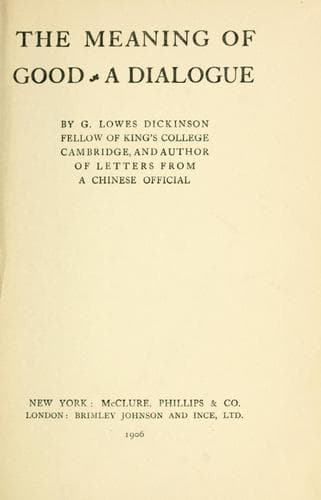
The Meaning of Good—A DialogueDickinson, G. Lowes (Goldsworthy Lowes)
Philosophy
The Meaning of Good—A Dialogue
Dickinson, G. Lowes (Goldsworthy Lowes)
Good and evil
"I agree with Audubon," he said. "For even if I admitted your general
contention, I should still maintain that it is not by virtue of any
conscious idea of Good that we introduce order into our lives. We
simply find ourselves, as a matter of fact, by nature and character,
preferring one object to another, suppressing or developing this or
that tendency. Our choices are not determined by our abstract notion
of Good; on the contrary, our notion of Good is deduced from our
choices."
"You mean, I suppose, that we collect from our particular choices our
general idea of the kind of things which we consider good. That may
be. But the point I insist upon is that we do attach validity to
these choices; they are, to us, our choices of our Good, those that we
approve as distinguished from those that we do not. And my contention
is that, in spite of all diversity of opinions as to what really are
the good things to choose, we are bound to attach, each of us, some
validity to our own, under penalty of reducing our life to a moral
chaos."
"But what do you mean by 'validity'?" asked Leslie. "Do you mean that
we must believe that our opinions are right?"
"Yes," I said, "or, at least, if not that they are right, that they
are the rightest we can attain to for the time being, and until we see
something righter. But above all, that opinions on this subject really
are either right or wrong, or more right and less right; and that of
this rightness or wrongness we really have some kind of perception,
however difficult it may be to give an account of it, and that in
accordance with such perception we may come to change our opinions or
those of other people, by the methods of discussion and persuasion and
the like. And all this, as I understand, is what Ellis was denying."
"Certainly," said Ellis, "I was; and I still do not see that you have
proved it."
"No," I said, "I have not even tried to. I have only tried to show
that in spite of your denial you really do believe it, because a
belief in it is implied in all your practical activity. And that, I
thought, you did admit yourself."
"But even so," he replied, "it remains to be considered whether my
theory is not more reasonable than my practice."
"Perhaps," I replied; "but that, I admit, is not the question that
really interests me. What I want to get at is the belief which
underlies the whole life of people like ourselves, and of which, it
seems, we cannot practically divest ourselves. And such a belief, I
think, is this which we have been discussing as to the validity of our
opinions about Good."
"I see," he said; "in fact you are concerning yourself not with
philosophy but with psychology."
"If you like; it matters little what you call it. Only, whatever it
be, you will do me a service if for the moment you will place yourself
at my standpoint, and see with me how things look from there."
Public-domain text, read in full here on John Shaqi.
Reviews
Reviews
No reviews yet
Be the first to share your thoughts on this work.
Join the Discussion
Join the discussion
Sign in to leave a comment or review.
Sign InorCreate an account