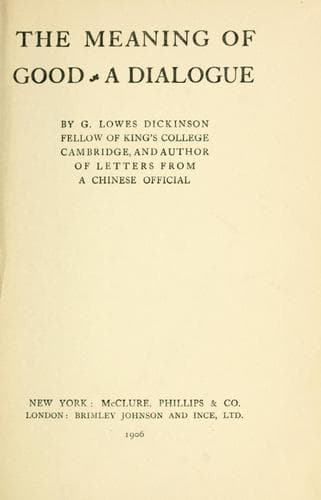
The Meaning of Good—A DialogueDickinson, G. Lowes (Goldsworthy Lowes)
Philosophy
The Meaning of Good—A Dialogue
Dickinson, G. Lowes (Goldsworthy Lowes)
Good and evil
"Very well," he said, "I have no objection, and so far, on the whole,
I do agree with you; though I am bound to point out that you might
easily find an opponent less complaisant. Your argument is very much
one _ad hominem_."
"It is," I said, "and that, I confess, is the only kind of argument in
which I much believe in these matters. I am content, for the present,
if you and the others here go along with me."
"I do," said Parry, "but you seem to me to be only stating, in an
unnecessarily elaborate way, what after all is a mere matter of common
sense."
"Perhaps it is," I replied, "though I have always thought myself
rather deficient in that kind of sense. But what does Leslie say?"
"Oh," he said, "I can't think how you can be content with anything so
lame and impotent! Some method there must be, absolute and _à priori_,
by which we may prove for certain that Good is, and discover, as well,
what things are good."
"Well," I said, "if there be such a method, you, if anyone, should
find it; and I wish you from my heart good luck in the quest. It is
only in default of anything better that I fall back on this--I dare
not call it method; this appeal to opinion and belief."
"And even so," said Ellis, "it is little enough that you have shown,
or rather, that I have chosen to admit. For even if it were granted
that individuals, in order to choose, must believe in Good, it doesn't
follow that they believe in anything except each a Good for himself.
So that, even on your own hypothesis, all we could say would be that
there are a number of different and perhaps incompatible Goods, each
good for some particular individual, but none necessarily good for
all. I, at least, admit no more than that."
"How do you mean?" I asked, "for I am getting lost again."
"I mean," he replied, "something that I should have thought was
familiar enough. Granted that there really is a Good which each
individual ought to choose, and does choose, if you like, as far as
he can see it; or granted, at least, that he is bound to believe this,
under penalty of reducing his life to moral chaos; still, I see no
reason to suppose that the thing which one individual ought to choose
is identical, or even compatible, with that which another ought to
choose. There may be a whole series of distinct and mutually exclusive
moral worlds. In other words, even though I may admit a Good for each,
I am not prepared to admit a Good for all."
"But then," I objected, "each of these Goods will also be a not-Good;
and that seems to be a contradiction."
"Not at all," he replied, "for each of them only professes to be Good
for me, and that is quite compatible with being Bad for another."
"But," cried Leslie, trembling with excitement, "your whole conception
is absurd. Good is simply Good; it is not Good for anybody or
anything; it is Good in its own nature, one, simple, immutable
eternal."
Public-domain text, read in full here on John Shaqi.
Reviews
Reviews
No reviews yet
Be the first to share your thoughts on this work.
Join the Discussion
Join the discussion
Sign in to leave a comment or review.
Sign InorCreate an account