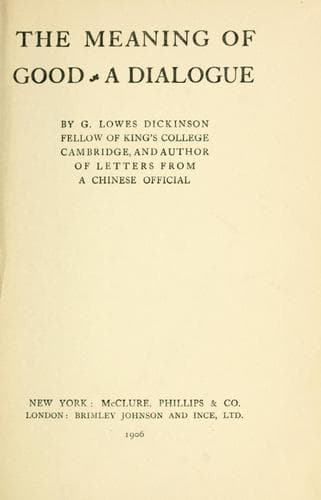
The Meaning of Good—A DialogueDickinson, G. Lowes (Goldsworthy Lowes)
Philosophy
The Meaning of Good—A Dialogue
Dickinson, G. Lowes (Goldsworthy Lowes)
Good and evil
"It may be," replied Ellis, "but I hope you will not actually tear me
to pieces if I humbly confess that I cannot see it. I see no reason to
admit any such Good; it even has no meaning to me."
"Well, anyhow, nothing else can have any meaning!"
"But, to me, something else has a meaning."
"Well, what?"
"Why, what I have been trying, apparently without success, to
explain."
"But don't you see that each of those things you call Goods, oughtn't
to be called Good at all, but each of them by some other particular
name of its own?"
"Oh, I don't want to quarrel about names; but I call each of them
Good because from one point of view--that of some particular
individual--each of them is something that ought to be. I, at any
rate, admit no more than that. For each individual there is something
that ought to be; but this, which ought to be for him, is very likely
something that ought not to be for somebody else."
On this Leslie threw himself back with a gesture of disgust and
despair; and I took the opportunity of intervening.
"Let us have some concrete instances," I said, "of these incompatible
Goods."
"By all means," he replied, "nothing can be simpler. It is good, say,
for Nero, to preserve supreme power; but it is bad for the people who
come in his way. It is good for an American millionaire to make and
increase his fortune; but it is bad for the people he ruins in the
process. And so on, _ad infinitum_; one has only to look at the
world to see that the Goods of individuals are not only diverse but
incompatible one with another."
"Of course," I said, "it is true that people do hold things to be good
which are in this way mutually incompatible. But does not the fact
of this incompatibility make one suspect that perhaps the things in
question are not really good?"
"It may, in some cases, but I see no ground for the suspicion. It
may very well be that what is good for me is in the nature of things
incompatible with what is good for you."
"I don't say it may not be so; but does one believe it to be so?
Doesn't one believe that what is really good for one must somehow be
compatible with what is really good for others?"
"Some people may believe it, but many don't; and it can never be
proved."
"No; and so I am driven back upon my argument _ad hominem_. Do not
you, as a matter of fact, believe it?"
"No, I don't know that I do."
"Do you believe then that there is nothing which is good for people in
general?"
"I don't see what is to prevent my believing it."
"But, at any rate you do not act as if you believed it."
"In what way do I not?"
"Why, for instance, you said last night that you intended to enter
Parliament."
"Well?"
"And in a few weeks you will be making speeches all over the country
in favour of--well, I don't quite know what--shall we say in favour of
the war?"
"Say so, by all means, if you like."
"And this war, I presume, you believe to be a good thing?"
"Well?"
Public-domain text, read in full here on John Shaqi.
Reviews
Reviews
No reviews yet
Be the first to share your thoughts on this work.
Join the Discussion
Join the discussion
Sign in to leave a comment or review.
Sign InorCreate an account