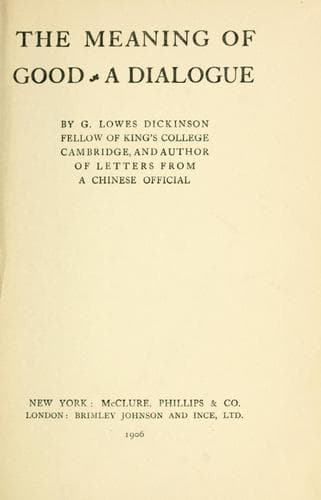
The Meaning of Good—A DialogueDickinson, G. Lowes (Goldsworthy Lowes)
Philosophy
The Meaning of Good—A Dialogue
Dickinson, G. Lowes (Goldsworthy Lowes)
Good and evil
In conclusion, there is one defect which is, I think, inherent in the
Dialogue form, even if it were treated with far greater skill than any
to which I can pretend. The connection of the various phases of the
discussion can hardly be as clearly marked as it would be in a formal
treatise; and in the midst of digressions and interruptions, such
as are natural in conversation, the main thread of the reasoning may
sometimes be lost I have therefore appended a brief summary of the
argument, set forth in its logical connections.
ARGUMENT
BOOK I.
I. After a brief introduction, the discussion starts with a
consideration of the diversity of men's ideas about Good, a diversity
which suggests _primâ facie_ a scepticism as to the truth of any of
these ideas.
The sceptical position is stated; and, in answer, an attempt is made
to show that the position is one which is not really accepted by
thinking men. For such men, it is maintained, regulate their lives by
their ideas about Good, and thus by implication admit their belief in
these ideas.
This is admitted; but the further objection is made, that for the
regulation of life it is only necessary for a man to admit a Good for
himself, without admitting also a General Good or Good of all. It is
suggested, in reply, that the conduct of thinking men commonly does
imply a belief in a General Good.
Against this it is urged that the belief implied is not in a Good
of all, but merely in the mutual compatibility of the Goods of
individuals; so that each whilst pursuing exclusively his own Good,
may also believe that he is contributing to that of others. In reply,
it is suggested (1) that such a belief is not borne out by fact;
(2) that the belief does itself admit a Good common to all, namely,
society and its institutions.
In conclusion, it is urged that to disbelieve in a General Good is to
empty life of what constitutes, for most thinking men, its main value.
II. The position has now been taken up (1) that men who reflect do,
whatever may be their theoretical opinion, imply, in their actual
conduct, a belief in their ideas about Good, (2) but that there seems
to be no certainty that such ideas are true. This latter proposition
is distasteful to some of the party, who endeavour to maintain that
there really is no uncertainty as to what is good.
Thus it is argued:
(1) That the criterion of Good is a simple infallible instinct. To
which it is replied that there appear to be many such 'instincts'
conflicting among themselves.
(2) That the criterion of Good is the course of Nature; Good being
defined as the end to which Nature is tending. To which it is replied
that such a judgment is as _a priori_ and unbased as any other, and as
much open to dispute.
It is then urged that if we reject the proposed criterion, we can have
no scientific basis for Ethics; which leads to a brief discussion of
the nature of Science, and the applicability of its methods to Ethics.
Public-domain text, read in full here on John Shaqi.
Reviews
Reviews
No reviews yet
Be the first to share your thoughts on this work.
Join the Discussion
Join the discussion
Sign in to leave a comment or review.
Sign InorCreate an account