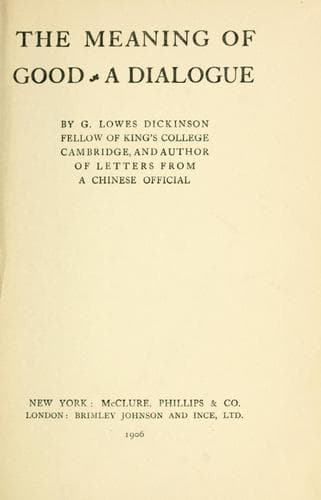
The Meaning of Good—A DialogueDickinson, G. Lowes (Goldsworthy Lowes)
Philosophy
The Meaning of Good—A Dialogue
Dickinson, G. Lowes (Goldsworthy Lowes)
Good and evil
(3) That the criterion of Good is current convention. To which it
is replied, that conventions are always changing, and that the moral
reformer is precisely the man who disputes those which are current.
Especially, it is urged that our own conventions are, in fact,
vigorously challenged, e.g. by Nietzsche.
(4) That the criterion of Good is Pleasure, or the "greatest happiness
of the greatest number." To which it is replied:
(a) That this view is not, as is commonly urged, in accordance with
'common sense.'
(b) That either Pleasure must be taken in the simplest and narrowest
sense; in which case it is palpably inadequate as a criterion of
Good; or its meaning must be so widely extended that the term Pleasure
becomes as indefinite as the term Good.
(c) That if the criterion of Pleasure were to be fairly applied, it
would lead to results that would shock those who profess to adopt it.
III. These methods of determining Good having been set aside, it is
suggested that it is only by 'interrogating experience' that we can
discover, tentatively, what things are good.
To this it is objected, that perhaps all our ideas derived from
experience are false, and that the only method of determining Good
would be metaphysical, and _a priori_. In reply, the bare possibility
of such a method is admitted; but it is urged that no one really
believes that all our opinions derived from experience are false,
and that such a belief, if held, would deprive life of all ethical
significance and worth.
Finally, it is suggested that the position in which we do actually
find ourselves, is that of men who have a real, though imperfect
perception of a real Good, and who are endeavouring, by practice, to
perfect that perception. In this respect an analogy is drawn between
our perception of Good and our perception of Beauty.
It is further suggested that the end of life is not merely a knowledge
but an experience of Good; this end being conceived as one to be
realised in Time.
IV. On this, the point is raised, whether it is not necessary to
conceive Good as eternally existing, rather than as something to be
brought into existence in the course of Time? On this view, Evil must
be conceived as mere 'appearance.'
In reply, it is suggested:
(1) That it is impossible to reconcile the conception of eternal Good
with the obvious fact of temporal Evil.
(2) That such a view reduces to an absurdity all action directed to
ends in Time. And yet it seems that such action not only is but ought
to be pursued, as appears to be admitted even by those who hold that
Good exists eternally, since they make it an end of action that they
should come to see that everything is good.
(3) That this latter conception of the end of action--namely, that we
should bring ourselves to see that what appears to be Evil is really
Good--is too flagrantly opposed to common sense to be seriously
accepted.
To sum up:
In this Book the following positions have been discussed and rejected:
Public-domain text, read in full here on John Shaqi.
Reviews
Reviews
No reviews yet
Be the first to share your thoughts on this work.
Join the Discussion
Join the discussion
Sign in to leave a comment or review.
Sign InorCreate an account