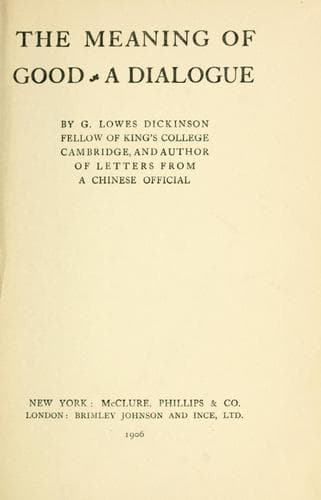
The Meaning of Good—A DialogueDickinson, G. Lowes (Goldsworthy Lowes)
Philosophy
The Meaning of Good—A Dialogue
Dickinson, G. Lowes (Goldsworthy Lowes)
Good and evil
"The theme, my dear Parry, is indeed a vast one, and suggests
countless developments. When, for example, we consider (to borrow your
own phrase) the reciprocal relations of the householder and the thief,
of the murderer and his victim, of the investor and the fraudulent
company-promoter; when, turning from these private examples, we cast
our eyes on international relations, when we observe the perfect
accord of interest between all the great powers in the far East;
when we note the smooth harmonious working of that flawless political
machine so aptly named the European Concert, each member pursuing its
own advantage, yet co-operating without friction to a common end; or
when, reverting to the economic sphere, we contemplate the exquisite
adjustment that prevails between the mutual interest of labour and
capital--an adjustment broken only now and again by an occasional
disturbance, just to show that the centre of gravity is changing;
when we observe the World Trust quietly, without a creak or a groan,
annihilating the individual producer; or when, to take the sublime
example which has already been quoted, we perceive a single
individual, in the pursuit of his own Good, positively co-operating
with revolutionists on the other side of the globe, and contributing,
by the process of starvation, to the deliverance of a great and
oppressed people--if indeed, in such a world as ours, anyone can
be said to be oppressed--when, my dear Parry, we contemplate these
things, then--then--words fail me! Finish the sentence as you only
can."
"Oh," said Parry, good-naturedly enough, "of course I know very well
you can make anything ridiculous if you like. But I still maintain
that we must take broad views of these matters, and that the position
adopted is substantially correct, if you take long enough periods
of time. Every man in the long run by pursuing his own Good does
contribute also to the Good of others."
"Well," I said, anxious to keep the argument to the main point,
"let us admit for the moment that it is so. You assert, then, that
everyone's Good is distinct from everyone else's, and that there is no
common Good; but that each one's pursuit of his own Good is essential
to the realization of the Good of all the rest"
"Yes," he said; "roughly, that is the kind of thing I believe."
"Well, but," I continued, "on that system there is at least one thing
which we shall have to call a common Good."
"And what is that?"
"Society itself! For society is the condition indispensable to
all alike for the realization of any individual Good; and a common
condition of Good is, I suppose, in a sense, a common Good."
"Yes," he replied, "I suppose, in a sense, it is."
Public-domain text, read in full here on John Shaqi.
Reviews
Reviews
No reviews yet
Be the first to share your thoughts on this work.
Join the Discussion
Join the discussion
Sign in to leave a comment or review.
Sign InorCreate an account