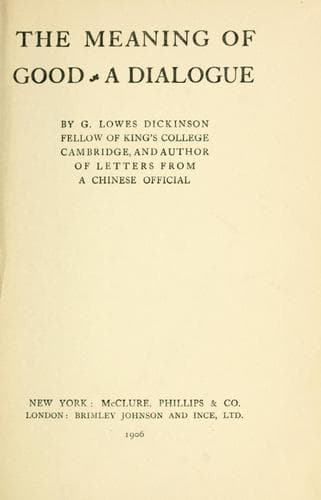
The Meaning of Good—A DialogueDickinson, G. Lowes (Goldsworthy Lowes)
Philosophy
The Meaning of Good—A Dialogue
Dickinson, G. Lowes (Goldsworthy Lowes)
Good and evil
"Well," I said, "I want no larger admission. For under 'society' what
is not included! Sanction society, and you sanction, or at least you
admit the possibility of a sanction for every kind of common activity
and end; and the motives of men in undertaking these common activities
become a matter of comparative indifference. Whatever they are
consciously aiming at, whether it be their own Good, or the Good of
all, or, as is more probable, a varying mixture of both, the fact
remains that they do, and we do, admit a common Good, the maintenance
and development of society itself. And that is all I was concerned to
get you to agree to."
"But," said Leslie, "do you really think that there is no common Good
except this, which you yourself admit to be rather a condition of Good
than Good itself?"
"No," I replied, "that is not my view. I do not, myself, regard
society as nothing but a condition of the realization of independent,
individual Goods. On the contrary, I think that the Good of each
individual consists in his relations with other individuals. But this
I do not know that I am in a position to establish. Meantime, however,
we can, I think, maintain, that few candid men, understanding the
issue, will really deny altogether a common Good; for they will have
to admit that in society we have at the very least a common condition
of Good."
"But still," objected Leslie, "even so we have no proof that there
is a common Good, but only that most civilized men, if pressed, would
probably admit one."
Public-domain text, read in full here on John Shaqi.
Reviews
Reviews
No reviews yet
Be the first to share your thoughts on this work.
Join the Discussion
Join the discussion
Sign in to leave a comment or review.
Sign InorCreate an account