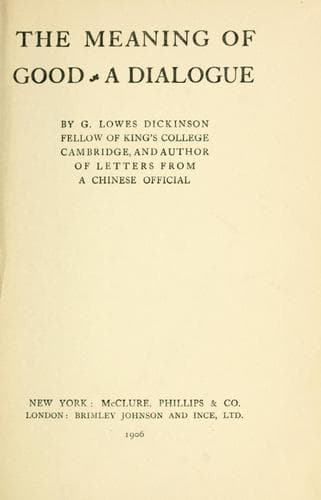
The Meaning of Good—A DialogueDickinson, G. Lowes (Goldsworthy Lowes)
Philosophy
The Meaning of Good—A Dialogue
Dickinson, G. Lowes (Goldsworthy Lowes)
Good and evil
"There you are again," said Parry, "with your crude rationalism! The
point is that the social habit has now become an instinct, and has
therefore, as I say, imperative authority! No operations of the reason
touch it in the least"
"Well," rejoined Ellis, "I must say that it seems to me very hard that
a man can't rectify such an important error. The imposition is simply
monstrous! Here are a number of fellows shut up in society on the
distinct understanding, to begin with, that society was to help them
to preserve their lives; instead of which, it starves them and hangs
them and sends them to be shot in battle, and they aren't allowed
to raise a word of protest or even to perceive what a fraud is being
perpetrated upon them!"
"I don't see that it's hard at all," replied Parry; "it seems to me
a beautiful device of nature to ensure the predominance of the better
instincts."
"The better instincts!" I cried, "but there is the point! These
instincts of yours, it seems, conflict; in battle, for example, the
instinct to run away conflicts with the instinct to stay and fight?"
"No doubt," he admitted.
"And sometimes one prevails and sometimes the other?"
"Yes."
"And in the one case we say that the man does right, when he stays and
fights; and in the other that he does wrong, when he runs away?"
"I suppose so."
"Well, then, how does your theory of instincts help us to know what is
Good? For it seems that after all we have to choose between instincts,
to approve one and condemn another. And our problem still remains, how
can we do this? how can we get any certainty of standard?"
"Perhaps the faculty that judges is itself an instinct?"
"Perhaps it is," I replied, "I don't really know what an instinct is.
My quarrel is not with the word instinct, but with what seemed to
be your assumption that whatever it is in us that judges about Good
judges in a single, uniform, infallible way. Whereas, in fact, as you
had to admit, sometimes at the same moment it pronounces judgments not
only diverse but contradictory."
"But," he replied, "those seem to me to be exceptional cases. As
a rule the difficulty doesn't occur. When it does, I admit that we
require a criterion. But I should expect to find it in science rather
than in philosophy."
"In science!" exclaimed Leslie. "What has science to do with it?"
"What has _not_ science to do with?" said a new voice from behind. It
was Wilson who, in his turn, had joined us from the breakfast room (he
always breakfasted late), and had overheard the last remark. He was a
lecturer in Biology at Cambridge, rather distinguished in that field,
and an enthusiastic believer in the capacity of the scientific method
to solve all problems.
"I was saying," Leslie repeated in answer to his question, "that
science has nothing to do with the Good."
"So much the worse for the Good," rejoined Wilson, "if indeed that be
true."
Public-domain text, read in full here on John Shaqi.
Reviews
Reviews
No reviews yet
Be the first to share your thoughts on this work.
Join the Discussion
Join the discussion
Sign in to leave a comment or review.
Sign InorCreate an account