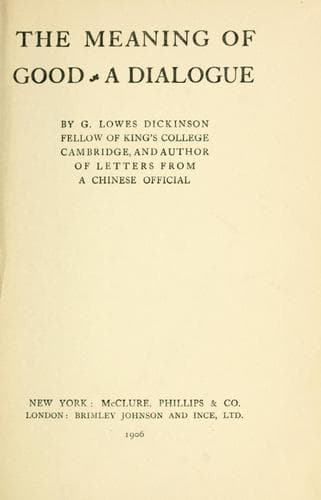
The Meaning of Good—A DialogueDickinson, G. Lowes (Goldsworthy Lowes)
Philosophy
The Meaning of Good—A Dialogue
Dickinson, G. Lowes (Goldsworthy Lowes)
Good and evil
"But you, I suppose, would never admit that it is," I interposed. I
was anxious to hear what he had to say, though at the same time I was
desirous to avoid a discussion between him and Leslie, for their types
of mind and habits of thought were so radically opposed that it was
as idle for them to engage in debate as for two bishops of opposite
colour to attempt to capture one another upon a chessboard. He
answered readily enough to my challenge.
"I think," he said, "that there is only one method of knowledge, and
that is the method we call scientific."
"But do you think there is any knowledge of Good at all, even by that
method? or that there is nothing but erroneous opinions?"
"I think," he replied, "that there is a possibility of knowledge, but
only if we abjure dialectics. Here, as everywhere, the only safe guide
is the actual concrete operation of Nature."
"How do you mean?" asked Leslie, his voice vibrating with latent
hostility.
"I mean that the real significance of what we call Good is only to
be ascertained by observing the course of Nature; Good being in fact
identical with the condition towards which she tends, and morality the
means to attaining it."
"But----" Leslie was beginning, when Parry cut him short.
"Wait a moment!" he said. "Let Wilson have a fair hearing!"
"This end and this means," continued Wilson, "we can only ascertain
by a study of the facts of animal and human evolution. Biology and
Sociology, throwing light back and forward upon one another, are
rapidly superseding the pseudo-science of Ethics."
"Oh dear!" cried Ellis, _sotto-voce_, "here comes the social organism!
I knew it would be upon us sooner or later."
"And though at present, I admit," proceeded Wilson, not hearing, or
ignoring, this interruption, "we are hardly in a position to draw any
certain conclusions, yet to me, at least, it seems pretty clear what
kind of results we shall arrive at."
"Yes!" cried Parry, eagerly, "and what are they?"
"Well," replied Wilson, "I will indicate, if you like, the position
I am inclined to take up, though of course it must be regarded as
provisional."
"Of course! Pray go on!"
"Well," he proceeded, "biology, as you know, starts with the single
cell----"
"How do you spell it?" said Ellis, with shameless frivolity, "with a C
or with an S?"
"Of these cells," continued Wilson, imperturbably, "every animal body
is a compound or aggregation; the aggregation involving a progressive
modification in the structure of each cell, the differentiation of
groups of cells to perform special functions,--digestive, respiratory,
and the rest,--and the subordination of each cell or group of cells to
the whole. Similarly, in sociology----"
"Dear Wilson," cried Ellis, unable any longer to contain himself,
"mightn't we take all this for granted?"
"Wait a minute," I said, "let him finish his analogy."
"That's just it!" cried Leslie, "it's nothing but an analogy. And I
don't see how----"
Public-domain text, read in full here on John Shaqi.
Reviews
Reviews
No reviews yet
Be the first to share your thoughts on this work.
Join the Discussion
Join the discussion
Sign in to leave a comment or review.
Sign InorCreate an account