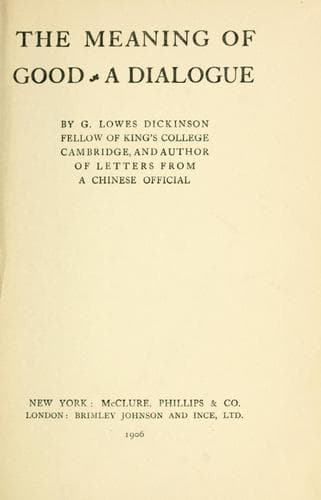
The Meaning of Good—A DialogueDickinson, G. Lowes (Goldsworthy Lowes)
Philosophy
The Meaning of Good—A Dialogue
Dickinson, G. Lowes (Goldsworthy Lowes)
Good and evil
"Hush, hush!" said Parry. "Do let him speak!"
"I was about to say," continued Wilson, "when I was interrupted, that
in the social organism----"
"Ah!" interjected Ellis, "here it is!"
"In the social organism, the individual corresponds to the cell, the
various trades and professions to the organs. Society has thus its
alimentary system, in the apparatus of production and exchange; its
circulatory system, in the network of communications; its nervous
system, in the government machinery; its----"
"By the bye," interrupted Ellis, "could you tell me, for I never could
find it in Herbert Spencer, what exactly in society corresponds to the
spleen?"
"Or the liver?" added Leslie.
"Or the vermiform appendix?" Ellis pursued.
"Oh, well," said Wilson, a little huffed at last, "if you are tired of
being serious it's no use for me to continue."
"I'm sorry, Wilson!" said Ellis. "I won't do it again; but one does
get a little tired of the social organism."
"More people talk about it," answered Wilson, "than really understand
it."
"Very true," retorted Ellis, "especially among biologists."
At this point I began to fear we should lose our subject in polemics;
so I ventured to recall Wilson to the real issue.
"Supposing," I said, "that we grant the whole of your position, how
does it help us to judge what is good?"
"Why," he said, "in this way. What we learn from biology is, that it
is the constant effort of nature to combine cells into individuals
and individuals into societies--the protozoon, in other words,
evolves into the animal, the animal into what some have called the
'hyper-zoon,' or super-organism. Well, now, to this physical evolution
corresponds a psychical one. What kind of consciousness an animal may
have, we can indeed only conjecture; and we cannot even go so far as
conjecture in the case of the cell; but we may reasonably assume
that important psychical changes of the original elements are
accompaniments and conditions of their aggregation into larger
entities; and the morality (if you will permit the word) of the cell
that is incorporated in an animal body will consist in adapting itself
as perfectly as may be to the new conditions, in subordinating its
consciousness to that of the Whole--briefly, in acquiring a social
instead of an individual self. And now, to follow the clue thus
obtained into the higher manifestations of life. As the cell is to the
animal, so is the individual to society, and that on the psychical as
well as on the physical side. Nature has perfected the animal; she
is perfecting society; that is the end and goal of all her striving.
When, therefore, you raise the question, what is Good, biology has
this simple answer to give you: Good is the perfect social soul in the
perfect social body."
As he concluded, Ellis exclaimed softly,"'_Parturiunt montes_,'" and
Leslie took it up with: "And not even a mouse!"
Public-domain text, read in full here on John Shaqi.
Reviews
Reviews
No reviews yet
Be the first to share your thoughts on this work.
Join the Discussion
Join the discussion
Sign in to leave a comment or review.
Sign InorCreate an account