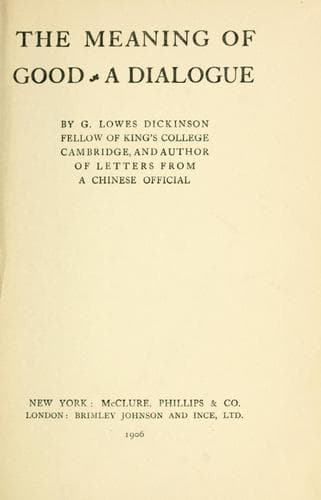
The Meaning of Good—A DialogueDickinson, G. Lowes (Goldsworthy Lowes)
Philosophy
The Meaning of Good—A Dialogue
Dickinson, G. Lowes (Goldsworthy Lowes)
Good and evil
"Well," I said, "for my own part, I am a good deal in sympathy with
what you say. At the same time there is a difficulty."
"A difficulty!" cried Leslie, "there are hundreds and thousands!"
"Perhaps," I replied, "but the particular one to which I was referring
is this. Every civilization, no doubt, has its own standard of Good;
but these standards are different and even opposite; so that it would
seem we require some criterion by which to compare and judge them."
"No," cried Parry, "that is just what I protest against. We are not
concerned with other ideals than our own. Every great civilization
believes in itself. Take, for instance, the ancient Greeks, of
whom you are so fond of talking. In my opinion they are absurdly
over-estimated; but they had at least that good quality--they believed
in themselves. To them the whole non-Greek world was barbarian; the
standard of Good was frankly their own standard; and it was a standard
knowable and known, however wide might be the deviations from it in
practice. We find accordingly that for them the ideal was rooted in
the real. Plato, even, in constructing his imaginary republic,
does not build in the void, evoking from his own consciousness
a Cloud-Cuckoo-city for the Birds; on the contrary, he bases
his structure upon the actual, following the general plan of the
institutions of Sparta and Crete; and neither to him nor to Aristotle
does it ever occur that there is, or could be, any form of state worth
considering, except the city-state with which they were familiar. It
is the same with their treatment of ethics; their ideal is that of
the Greeks, not of Man in general, and stands in close relation to the
facts of contemporary life. So, too, with their art; it is not,
like that of our modern romanticists, an impotent yearning for
vaguely-imagined millenniums. On the contrary, it is an ideal
interpretation of their own activity, a mirror focussing into feature
and form the very same fact which they saw distorted and blurred in
the troubled stream of time. The Good, in the Greek world, was simply
the essence and soul of the Real; and the Socrates of Xenophon who
frankly identified justice with the laws, was only expressing, and
hardly with exaggeration, the current convictions of his countrymen.
That, to my mind, is the attitude of health; and it is the one natural
to the plain man in every well-organized society. Good is best known
when it is not investigated; and people like ourselves would do no
useful service if we were to induce in others the habit of discussion
which education has made a second nature to ourselves."
"My dear Parry!" cried Ellis, "you alarm me! Is it possible that we
are all anarchists in disguise?"
"Parry," I observed, "seems to agree with the view attributed by
Browning to Paracelsus, that thought is disease, and natural health is
ignorance."
"Well," rejoined Ellis, "there is a good deal to be said for that."
Public-domain text, read in full here on John Shaqi.
Reviews
Reviews
No reviews yet
Be the first to share your thoughts on this work.
Join the Discussion
Join the discussion
Sign in to leave a comment or review.
Sign InorCreate an account