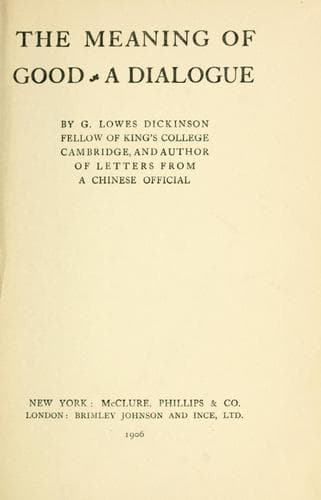
The Meaning of Good—A DialogueDickinson, G. Lowes (Goldsworthy Lowes)
Philosophy
The Meaning of Good—A Dialogue
Dickinson, G. Lowes (Goldsworthy Lowes)
Good and evil
"There's a good deal to be said for everything," I rejoined. "But
if thought indeed be disease, we must recognise the fact that we are
suffering from it; and so, I fear, is the whole modern world. It was
easy for the Greeks to be 'healthy'; practically they had no past. But
for us the past overweights the present; we cannot, if we would,
get rid of the burden of it. All that was once absolute has become
relative, including our own conceptions and ideals; and as we look
back down the ages and see civilization after civilization come into
being, flourish and decay, it is impossible for us to believe that
the society in which we happen to be born is more ultimate than any
of these, or that its ideal, as reflected in its institutions, has
any more claim than theirs to be regarded as a final and absolute
expression of Good."
"Well," said Parry, "let us admit, if you like, that ideals evolve,
but, in any case, the ideal of our own time has more validity for
us than any other. As to those of the past, they were, no doubt,
important in their day, but they have no importance for the modern
world. The very fact that they are past is proof that they are also
superseded."
"What!" cried Leslie, indignantly, "do you mean to say that everything
that is later in time is also better? That we are better artists than
the Greeks? better citizens than the Romans? more spiritual than the
men of the Middle Ages? more vigorous than those of the Renaissance?"
"I don't know," replied Parry, "that I am bound to maintain all that.
I only say that on the whole I believe that ideals progress; and that
therefore it is the ideals of our own time, and that alone, which we
ought practically to consider."
"The ideal of our own time?" I said, "but which of them? there are so
many."
"No, there is really only one, as I said before; the one that is
embodied in current laws and customs."
"But these are always themselves in process of change."
"Yes, gradual change."
"Not necessarily gradual; and even if it were, still change. And to
sanction a change, however slight, may always mean, in the end, the
sanctioning of a whole revolution."
"Besides," cried Leslie, "even if there were anything finally
established, what right have we to judge that the established is the
Good?"
"I don't know that we have any right; but I am sure it is what we do."
"Perhaps we do, many of us," I said, "but always, so far as we
reflect, with a lurking sense that we may be all wrong. Or how else do
you account for the curious, almost physical, sinking and disquiet we
are apt to experience in the presence of a bold denier?"
"I don't know that I do experience it."
"Do you not? I do so often; and only yesterday I had a specially vivid
experience of the kind."
"What was that?"
"Well, I was reading Nietzsche."
"Who is he?"
"A German writer. It does not much matter, but I had him in my mind
when I was speaking."
"Well, but what does he say?"
"It's not so much what he says, as what he denies."
Public-domain text, read in full here on John Shaqi.
Reviews
Reviews
No reviews yet
Be the first to share your thoughts on this work.
Join the Discussion
Join the discussion
Sign in to leave a comment or review.
Sign InorCreate an account