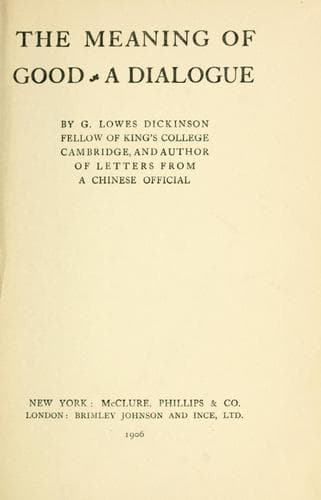
The Meaning of Good—A DialogueDickinson, G. Lowes (Goldsworthy Lowes)
Philosophy
The Meaning of Good—A Dialogue
Dickinson, G. Lowes (Goldsworthy Lowes)
Good and evil
"What does he deny, then?"
"Everything that you, I suppose, would assert. I should conjecture,
at least, that you believe in progress, democracy, and all the rest of
it."
"Well?"
"Well, he repudiates all that. Everything that you would reckon as
progress, he reckons as decadence. Democracy he regards, with all that
it involves, as a revolt of the weak against the strong, of the bad
against the good, of the herd against the master. Every great society,
in his view, is aristocratic, and aristocratic in the sense that the
many are deliberately and consciously sacrificed to the few; and
that, not as a painful necessity, but with a good conscience, in free
obedience to the universal law of the world. 'Be strong, be hard' are
his ultimate ethical principles. The modern virtues, or what we affect
to consider such, sympathy, pity, justice, thrift, unselfishness and
the like, are merely symptoms of moral degeneration. The true and
great and noble man is above all things selfish; and the highest type
of humanity is to be sought in Napoleon or Cæsar Borgia."
"But that's mere raving!"
"So you are pleased to say; and so, indeed, it really may be. But
not simply because it contradicts those current notions which we are
embodying, as fast as we can, in our institutions. It is precisely
those notions that it challenges; and it is idle to meet it with a
bare denial."
"I can conceive no better way of meeting it!"
"Perhaps, for purposes of battle. Yet, even so, you would surely be
stronger if you had reason for your faith."
"But I think my reason sufficient--those are not the ideas of the
age."
"But for all you know they may be those of the next."
"Well, that will be its concern."
"But surely, on your own theory, it must also be yours; for you said
that the later was also the better. And the better, I suppose, is what
you want to attain."
"Well!"
"Well then, in supporting the ideas and institutions generally
current, you may be hindering instead of helping the realization of
the Good you want to achieve."
"But I don't believe Nietzsche's ideas ever could represent the Good!"
"Why not?"
"Because I don't."
"But, at any rate, do you abandon the position that we can take the
ideas of our time as a final criterion?"
"I suppose so--I don't know--I'm sure there's something in it! Do you
believe yourself that they have no import for us?"
"I didn't say that; but I think we have to find what the import is.
We cannot substitute for our own judgment the mere fact of a current
convention, any more than we can substitute the mere fact of the
tendency of Nature. For, after all, it is the part of a moral reformer
to modify the convention. Or do you not think so?"
"Perhaps," he admitted, "it may be!"
Public-domain text, read in full here on John Shaqi.
Reviews
Reviews
No reviews yet
Be the first to share your thoughts on this work.
Join the Discussion
Join the discussion
Sign in to leave a comment or review.
Sign InorCreate an account