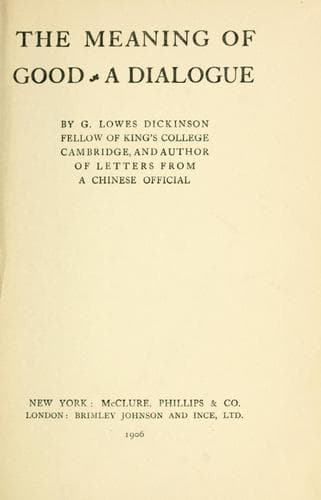
The Meaning of Good—A DialogueDickinson, G. Lowes (Goldsworthy Lowes)
Philosophy
The Meaning of Good—A Dialogue
Dickinson, G. Lowes (Goldsworthy Lowes)
Good and evil
"I hold no doctrine," interrupted Bartlett; "I merely expressed an
opinion, which I am not likely to change for all the philosophy in
the world." And with that he opened the _Chronicle_, and presently
becoming absorbed, paid for some time no further attention to the
course of our debate.
"Well," I continued, "the doctrine, whether Bartlett holds it or
no, that the ultimately good thing is the greatest happiness of the
greatest number, cannot be insisted upon as one which appeals at
once to everyone's consciousness as true, so that, in fact, since its
enunciation, the controversy about Good may be regarded as closed. It
will hardly be maintained, I imagine, even by Parry, that the truth of
the doctrine is a direct and simple intuition, so that it has only to
be stated to be accepted?"
"Certainly not," Parry replied, "the contention of the Utilitarians
is that everyone who has the capacity and will take the trouble to
reflect will, in fact, arrive at their conclusions."
"The conclusions being like other conclusions about what is good, the
result of a difficult process of analysis, in which there are many
possibilities of error, and no more self-evident and simple than any
other judgment of the kind?"
He agreed.
"And further, the general principle, tentative and uncertain as it is,
requiring itself to be perpetually interpreted anew for every fresh
case that turns up."
"How do you mean?"
"Why," I said, "even if we grant that the end of action is the
greatest happiness of the greatest number, yet we have still to
discover wherein that happiness consists."
"But," he said, "happiness we define quite simply as pleasure."
"Yes; but how do we define pleasure?"
"We don't need to define it. Pleasure and pain are simply sensations.
If I cut my finger, I feel pain; if I drink when I am thirsty, I
feel pleasure. There can be no mistake about these feelings; they are
simple and radical."
"Undoubtedly. But if you limit pleasure and pain to such simple cases
as these, you will never get out of them a system of Ethics. And, on
the other hand, if you extend the terms indefinitely, they lose at
once all their boasted precision, and become as difficult to interpret
as Good and Evil."
"How do you mean?"
"Why," I said, "if all conduct turned on such simple choices as that
between thick soup and clear, then perhaps its rules might be fairly
summed up in the utilitarian formula. But in fact, as everyone knows,
the choices are far more difficult; they are between, let us say, a
bottle of port and a Beethoven symphony; leisure and liberty now, or
£1000 a-year twenty years hence; art and fame at the cost of health,
or sound nerves and obscurity; and so on, and so on through all
the possible cases, infinitely more complex in reality than I could
attempt to indicate here, all of which, no doubt, could be brought
under your formula, but none of which the formula would help to
solve."
Public-domain text, read in full here on John Shaqi.
Reviews
Reviews
No reviews yet
Be the first to share your thoughts on this work.
Join the Discussion
Join the discussion
Sign in to leave a comment or review.
Sign InorCreate an account