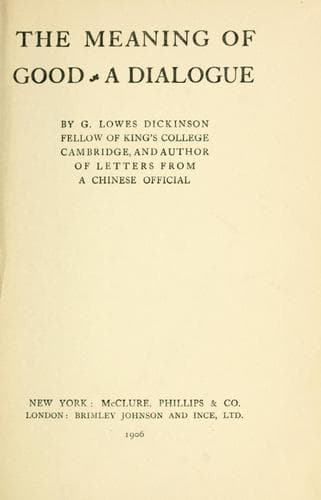
The Meaning of Good—A DialogueDickinson, G. Lowes (Goldsworthy Lowes)
Philosophy
The Meaning of Good—A Dialogue
Dickinson, G. Lowes (Goldsworthy Lowes)
Good and evil
"Of course," said Parry, "the hedonistic calculus is difficult to
apply. No one, that I know of, denies that."
"No one could very well deny it," I replied. "But now, see what
follows. Granting, for the moment, for the sake of argument, that in
making these difficult choices we really do apply what you call the
hedonistic calculus--"
"Which I, for my part, altogether deny!" cried Leslie.
"Well," I resumed, "but granting it for the moment, yet the important
point is not the criterion, but the result. It is a small thing to
know in general terms (supposing even it were true that we do know it)
that what we ought to seek is a preponderance of pleasure over pain;
the whole problem is to discover, in innumerable detailed cases,
wherein precisely the preponderance consists. But this can only be
learnt, if at all, by long and difficult, and, it may be, painful
experience. We do not really know, _à priori_, what things are
pleasurable, in the extended sense which we must give to the word if
the doctrine is to be at all plausible, any more definitely than we
know what things are good. And the Utilitarians by substituting
the word Pleasure for the word Good, even if the substitution were
legitimate, have not really done much to help us in our choice."
"But," he objected, "we do at least know what Pleasure is, even if we
do not know what things are pleasurable."
"And so I might say we do know what Good is, even if we do not know
what things are good."
"But we know Pleasure by direct sensation."
"And so I might say we know Good by direct perception."
"But you cannot define Good."
"Neither can you define Pleasure. Both must be recognised by direct
experience."
"But, at any rate," he said, "there is this distinction, that in the
case of Pleasure everyone _does_ recognise it when it occurs; whereas
there is no such general recognition of Good."
"That," I admitted, "may, perhaps, be true; I am not sure."
"But," broke in Leslie, "what does it matter whether it be true or
no? What has all this to do with the question? It's immaterial whether
Pleasure or Good is the more easily and generally recognisable. The
point is that they are radically different things."
"No," objected Parry, "_our_ point is that they are the same thing."
"But I don't believe you really think so, or that anyone can."
"And _I_ don't believe that anyone _cannot_!"
"Do you mean to say that you really agree with Bentham that, quantity
of pleasure being equal, pushpin is as good as poetry?"
"Yes; at least I agree with what he means, though the particular
example doesn't appeal to me, for I hardly know what either pushpin or
poetry is."
"Well then, let us take Plato's example. Do you think that, quantity
of pleasure being equal, scratching oneself when one itches is as good
as, say, pursuing scientific research."
"Yes. But of course the point is that quantity of pleasure is not
equal."
"You mean," interposed Ellis, "that there is more pleasure in
scratching?"
Public-domain text, read in full here on John Shaqi.
Reviews
Reviews
No reviews yet
Be the first to share your thoughts on this work.
Join the Discussion
Join the discussion
Sign in to leave a comment or review.
Sign InorCreate an account