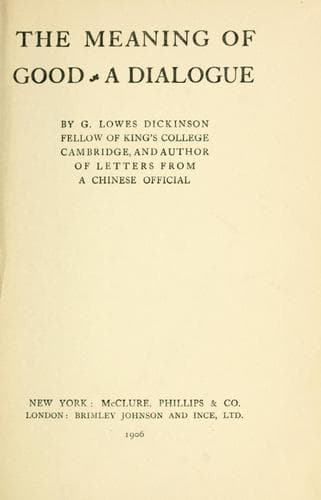
The Meaning of Good—A DialogueDickinson, G. Lowes (Goldsworthy Lowes)
Philosophy
The Meaning of Good—A Dialogue
Dickinson, G. Lowes (Goldsworthy Lowes)
Good and evil
For some minutes it seemed as though we had. The mid-day heat (it was
now twelve o'clock) and the silence broken only by the murmur of
the fountain (for the mowers opposite had gone home to their dinner)
seemed to have induced a general disinclination to the effort of
speech or thought Even Dennis whom I had never known to be tired in
body or mind, and who was always debating something--it seemed to
matter very little what--even he, I thought at first, was ready to let
the discussion drop. But presently it became clear that he was only
revolving my last words in his mind, for before long he turned to me
and said:
"I don't know what you mean by 'interrogating experience,' or what
results you hope to attain by that process." At this Leslie pricked
up his ears, and I saw that he at least was as eager as ever to pursue
the subject further.
"Why," continued Dennis, "should there not be a method of discovering
Good independently of all experience?"
The phrase immediately arrested Wilson's attention.
"'A method independent of experience,'" he cried, "why, what kind of a
method would that be?"
"It is not so easy to describe," replied Dennis. "But I was thinking
of the kind of method, for example, that is worked out by Hegel in his
_Logic_?"
"I have never read Hegel," said Wilson. "So that doesn't convey much
to my mind."
"Well," said Dennis, "I am afraid I can't summarize him!"
"Can't you?" cried Ellis, "I can! Here he is in a nutshell! Take any
statement you like--for example, 'Nothing exists!'--put it into the
dialectical machine, turn the handle, and hey presto! out comes the
Absolute! The thing's infallible; it does not matter what you put in;
you always get out the same identical sausage."
Dennis laughed. "There, Wilson," he said, "I hope you understand now!"
"I can't say I do," replied Wilson, "but I daresay it doesn't much
matter."
"Perhaps, then," said Ellis, "you would prefer the Kantian plan."
"What is that?"
"Oh, it's much simpler than the other. You go into your room, lock the
door, and close the shutters, excluding all light Then you proceed
to invert the mind, so as to relieve it of all its contents; look
steadily into the empty vessel, as if it were a well; and at the
bottom you will find Truth in the form of a categorical imperative.
Or, if you don't like that, there's the method of Fichte. You take an
Ego, by preference yourself; convert it into a proposition; negate it,
affirm it, negate it again, and so on _ad infinitum_, until you get
out the whole Universe in the likeness of yourself. But that's rather
a difficult method; probably you would prefer Spinoza's. You take--"
"No!" cried Dennis, "there I protest! Spinoza is too venerable a
name."
"So are they all, all venerable names," said Ellis. "But the question
is, to which of them do you swear allegiance? For they all arrive at
totally different results."
Public-domain text, read in full here on John Shaqi.
Reviews
Reviews
No reviews yet
Be the first to share your thoughts on this work.
Join the Discussion
Join the discussion
Sign in to leave a comment or review.
Sign InorCreate an account