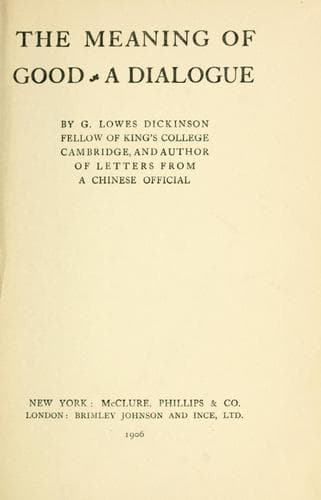
The Meaning of Good—A DialogueDickinson, G. Lowes (Goldsworthy Lowes)
Philosophy
The Meaning of Good—A Dialogue
Dickinson, G. Lowes (Goldsworthy Lowes)
Good and evil
"No, of course not."
"But at least you will admit that there is more pleasure in some
physical experiences? Plato, for example, takes the case of a
catamite."
"I admit nothing of the kind. In the first place, these gross physical
pleasures do not last."
"But suppose they did? Imagine an eternal, never-changing bliss of
scratching, or of--"
"I don't see the use of discussing the matter in this kind of way. It
seems to me to deserve serious treatment"
"But I am perfectly serious. I do genuinely believe that a heaven of
scratching, or at any rate of some analogous but intenser experience,
would involve an indefinitely greater sum of pleasure than a heaven of
scientific research."
"Well, all I can say is, I don't agree with you."
"But why not?" cried Leslie. "If you were candid I believe you would.
The fact is that you have predetermined that scientific research is a
better thing than such physical pleasure, and then you bring out your
calculation of pleasure so as to agree with that foregone conclusion.
And that is what the Utilitarians always do. Being ordinary decent
people they accept the same values as the rest of the world, and on
the same grounds as the rest of the world. And then they pretend,
and no doubt believe themselves, that they have been led to their
conclusions by the hedonistic calculus. But really, if they made an
impartial attempt to apply the calculus fairly, they would arrive
at quite different results, results which would surprise and shock
themselves, and destroy the whole plausibility of their theory."
"That is your view of the matter."
"But isn't it yours?"
"No, certainly not."
"At any rate," I interposed, "it seems to be clear that this
utilitarian doctrine has nothing absolute or final or self-evident
about it. All we can say is that among the many opinions about what
things are good, there is also this opinion, very widely held, that
all pleasurable things are good, and that nothing is good that is not
pleasurable. But that, like any other opinion, can be and is disputed.
So that we return pretty much to the point we left, that there are
a number of conflicting opinions about what things are good, that
to these opinions some validity must be attached, but that it is
difficult to see how we are to reconcile them or to choose between
them. Only, somehow or other, as it seems to me, the truth about Good
must be adumbrated in these opinions, and by interrogating the actual
experience of men in their judgments about good things, we may perhaps
be able to get at least some, shadowy notion of the object of our
quest"
"And so," said Ellis, getting up and stretching himself, "even by your
own confession we end where we began."
"Not quite," I replied. "Besides, have we ended?"
Public-domain text, read in full here on John Shaqi.
Reviews
Reviews
No reviews yet
Be the first to share your thoughts on this work.
Join the Discussion
Join the discussion
Sign in to leave a comment or review.
Sign InorCreate an account