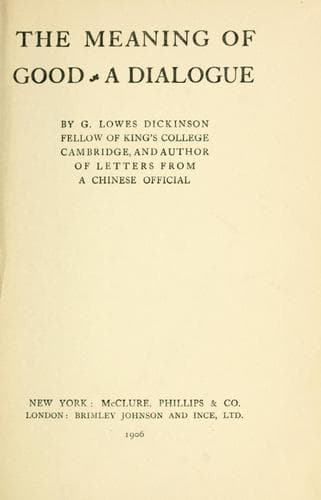
The Meaning of Good—A DialogueDickinson, G. Lowes (Goldsworthy Lowes)
Philosophy
The Meaning of Good—A Dialogue
Dickinson, G. Lowes (Goldsworthy Lowes)
Good and evil
"Heard melodies are sweet, but those unheard
Are sweeter; therefore, ye soft pipes, play on;
Not to the sensual ear, but, more endear'd.
Pipe to the spirit ditties of no tone;
Fair youth beneath the trees, thou canst not leave
Thy song, nor ever can those trees be bare;
Bold lover, never, never canst thou kiss,
Though winning near the goal--yet, do not grieve;
She cannot fade, though thou hast not thy bliss,
For ever wilt thou love and she be fair!
"Ah, happy, happy boughs! that cannot shed
Your leaves, nor ever bid the spring adieu;
And, happy melodist, unwearied,
For ever piping songs for ever new;
More happy love! more happy, happy love!
For ever warm and still to be enjoyed,
For ever panting and for ever young;
All breathing human passion far above,
That leaves a heart high-sorrowful and cloyed,
A burning forehead, and a parching tongue."
"Well," said Parry, when I had done, "that's very pretty; but I don't
see how it bears on the argument."
"I think," I replied, "that it illustrates the point I wanted to make.
Part, I mean, of the peculiar charm of works of Art consists in the
fact that they arrest a fleeting moment of delight, lift it from our
sphere of corruption and change, and fix it like a star in the eighth
heaven."
"Yes," said Ellis, "we grant you that"
"Or at least," added Parry, "we don't care to dispute it"
"And the other point which I want to make is, I think, clearer
still--that the Good of works of Art, that is to say their Beauty,
results from the very principle of their nature, and is not a mere
accident of circumstances."
"Of course," said Leslie, "their Beauty is their only _raison d'être_?"
"And yet," I went on, "they are still Goods of sense, and so far
resemble the other Goods of which we were speaking before."
"Yes," said Dennis, "but with what a difference! That is the point I
have been waiting to come to."
"What point?" I asked.
"Why," he said, "in the case of what you call Goods of sense, in their
simplest and purest form, making abstraction from all æsthetic
and other elements--as in the example you gave of a cold bath--the
relation of the object to the sense is so simple and direct, that
really, if we were to speak accurately, we should have, I think, to
say, that so far as the perception of Good is concerned the object is
merged in the subject, and what you get is simply a good sensation."
"Perhaps," I agreed, "that is how we ought to put it. But at the time
I did not think it necessary to be so precise."
"But it has become necessary now, I think," he replied, "if we are to
bring out a characteristic of works of Art which will throw light, I
believe, on the general nature of Good."
"What characteristic is that?"
Public-domain text, read in full here on John Shaqi.
Reviews
Reviews
No reviews yet
Be the first to share your thoughts on this work.
Elsewhere in the archive
Join the Discussion
Join the discussion
Sign in to leave a comment or review.
Sign InorCreate an account