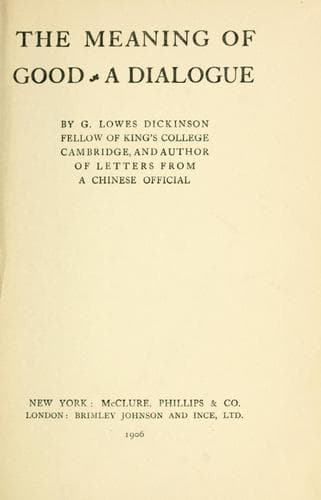
The Meaning of Good—A DialogueDickinson, G. Lowes (Goldsworthy Lowes)
Philosophy
The Meaning of Good—A Dialogue
Dickinson, G. Lowes (Goldsworthy Lowes)
Good and evil
"In a sense perhaps you do; but not in the sense which seems to me
most important. I mean that when it comes to the point, you act, and
are practically bound to act, upon your opinion about what is good, as
though you did believe it to be true."
"How do you mean 'practically bound?'"
"I mean that it is only by so acting that you are able to introduce
any order or system into your life, or in fact to give it to yourself
any meaning at all. Without the belief that what you hold to be good
really somehow is so, your life, I think, would resolve itself into
mere chaos."
"I don't see that"
"Well, I may be wrong, but my notion is that what systematizes a life
is choice; and choice, I believe, means choice of what we hold to be
good."
"Surely not! Surely we may choose what we hold to be bad."
"I doubt it"
"But how then do you account for what you call bad men?"
"I should say they are men who choose what I think bad but they think
good."
"But are there not men who deliberately choose what they think bad,
like Milton's Satan--'Evil be thou my Good'?"
"Yes, but by the very terms of the expression he was choosing what he
thought good; only he thought that evil was good."
"But that is a contradiction."
"Yes, it is the contradiction in which he was involved, and in which I
believe everyone is involved who chooses, as you say, the Bad. To them
it is not only bad, it is somehow also good."
"Does that apply to Nero, for example?"
"Yes, I think it very well might; the things which he chose, power and
wealth and the pleasures of the senses, he chose because he thought
them good; if his choice also involved what he thought bad, such as
murder and rapine and the like (if he did think these bad, which I
doubt), then there was a contradiction not so much in his choice as in
its consequences. But even if I were to admit that he and others have
chosen and do choose what they believe to be bad, it would not affect
the point I want to make. For to choose Bad must be, in your view, as
absurd as to choose Good; since, I suppose, you do not believe, that
our opinions about the one have any more validity than our opinions
about the other. So that if we are to abandon Good as a principle of
choice, it is idle to say we may fall back upon Bad."
"No, I don't say that we may; nor do I see that we must We do not
need either the one or the other. You must have noticed--I am sure I
have--that men do not in practice choose with any direct reference to
Good or Bad; they choose what they think will bring them pleasure, or
fame, or power, or, it may be, barely a livelihood."
"But believing, surely, that these things are good?"
"Not necessarily; not thinking at all about it, perhaps."
"Perhaps not thinking about it as we are now; but still, so far
believing that what they have chosen Is good, that if you were to go
to them and suggest that, after all, it is bad they would be seriously
angry and distressed."
Public-domain text, read in full here on John Shaqi.
Reviews
Reviews
No reviews yet
Be the first to share your thoughts on this work.
Join the Discussion
Join the discussion
Sign in to leave a comment or review.
Sign InorCreate an account