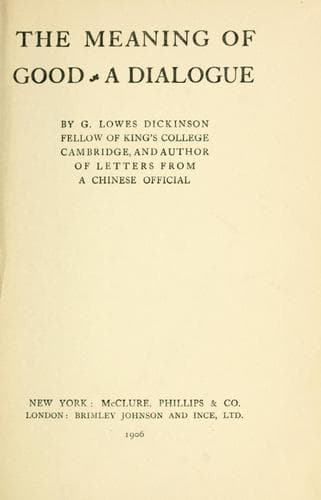
The Meaning of Good—A DialogueDickinson, G. Lowes (Goldsworthy Lowes)
Philosophy
The Meaning of Good—A Dialogue
Dickinson, G. Lowes (Goldsworthy Lowes)
Good and evil
"Well," he said, "the effect of mine has been to bring home to me,
in a way I could never realize before, the extraordinary diversity of
men's ideals."
"That, you find, is the effect of travel?"
"I think so. Travelling really does open the eyes. For instance, until
I went to the East I never really felt the antagonism between the
Oriental view of life and our own. Now, it seems to me clear that
either they are mad or we are; and upon my word, I don't know which.
Of course, when one is here, one supposes it is they. But when one
gets among them and really talks to them, when one realizes how
profound and intelligent is their contempt for our civilization,
how worthless they hold our aims and activities, how illusory our
progress, how futile our intelligence, one begins to wonder whether,
after all, it is not merely by an effect of habit that one judges them
to be wrong and ourselves right, and whether there is anything at
all except blind prejudice in any opinions and ideas about Right and
Wrong."
"In fact," interposed Audubon, "you agree, like me, with Sir Richard
Burton:
"'There is no good, there is no bad, these be the whims of mortal will;
What works me weal that call I good, what harms and hurts I hold as ill.
They change with space, they shift with race, and in the veriest span of
time,
Each vice has worn a virtue's crown, all good been banned as sin or
crime.'"
"Yes," he assented, "and that is what is brought home to one by
travel. Though really, if one had penetration enough, it would not be
necessary to travel to make the discovery. A single country, a single
city, almost a single village, would illustrate, to one who can look
below the surface, the same truth. Under the professed uniformity of
beliefs, even here in England, what discrepancies and incongruities
are concealed! Every type, every individual almost, is distinguished
from every other in precisely this point of the judgments he makes
about Good. What does the soldier and adventurer think of the life of
a studious recluse? or the city man of that of the artist? and vice
versa? Behind the mask of good manners we all of us go about judging
and condemning one another root and branch. We are in no real
agreement as to the worth either of men or things. It is an illusion
of the 'canting moralist' (to use Stevenson's phrase) that there is
any fixed and final standard of Good. Good is just what any one thinks
it to be; and one man has as much right to his opinion as another."
"But," I objected, "it surely does not follow that because there are
different opinions about Good, they are all equally valuable."
"No. I should infer rather that they are all equally worthless."
"That does not seem to me legitimate either; and I venture to doubt
whether you really believe it yourself."
"Well, at any rate I am inclined to think I do."
Public-domain text, read in full here on John Shaqi.
Reviews
Reviews
No reviews yet
Be the first to share your thoughts on this work.
Join the Discussion
Join the discussion
Sign in to leave a comment or review.
Sign InorCreate an account