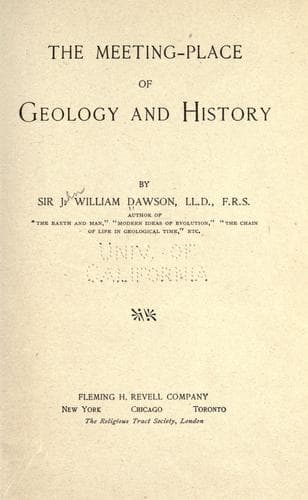
The Meeting-Place of Geology and HistoryDawson, John William, Sir
Religion
The Meeting-Place of Geology and History
Dawson, John William, Sir
Deluge; Prehistoric peoples
There still seems reason to believe that remains of man and his works
exist in beds which are overlaid by boulders and gravel, implying a cold
climate. These may indicate the last portion of the glacial period
proper, in which case the beds with human remains may be called
inter-glacial, or they may indicate a partial relapse to the cold
conditions occurring after the glacial age had passed away, and in the
early part of the modern period. My own view is, that it is most natural
to draw the boundary line of the pleistocene and anthropic or modern at
the point where the earliest certain evidences of man appear, and that
the anthropic age will be found to include not only an early period of
mild climate succeeding the glacial age, but a little later a return of
cold, not comparable with that of the extreme glacial period, but
sufficient seriously to affect human interests, and which almost
immediately preceded those physical changes which carried away
palæocosmic man, or the man of the earliest period, and many of his
companion animals, and introduced the neanthropic or later human age. We
shall find facts bearing on this in the sequel.
In the meantime, we may consider it as established beyond cavil that man
was already in Europe immediately after the close of the glacial period,
and was contemporary with the species of animals, many of them large
and formidable, which at that time occupied the land. He must have
entered on the possession of a world more ample and richer in resources
than that which remains to us. The early post-glacial age was, like the
preceding pliocene, a time of continental elevation, in which the dry
land spread itself widely over the now submerged margins of the sea
basins. In Europe, the British Islands were connected with the mainland,
and Ireland was united to England. The Rhine flowed northward to the
Orkneys, through a wide plain probably wooded and swarming with great
quadrupeds, now extinct or strange to Europe. The Thames and the Humber
were tributaries of the Rhine. The land of France and Spain extended out
to the hundred-fathom line. The shallower parts of the Mediterranean
were dry land, and that sea was divided into two parts by land
connecting Italy with Africa. Possibly portions of the shallower areas
of the Atlantic were so elevated as to connect Europe and America more
closely than at present.
Connected with this elevation of the continents out of the sea was a
great change of climate, whereby the cold of the pleistocene age passed
away and a milder climate overspread the northern hemisphere, while the
newly-raised land and that vacated by snow and ice became clothed with
vegetation, and were occupied by a rich quadrupedal fauna, including
even in the northern parts of Europe, Asia, and America, species of
elephant, rhinoceros, and other genera now confined to the warmer
climates. This new and noble world was the rich heritage of primeval
man.
Public-domain text, read in full here on John Shaqi.
Reviews
Reviews
No reviews yet
Be the first to share your thoughts on this work.
Join the Discussion
Join the discussion
Sign in to leave a comment or review.
Sign InorCreate an account