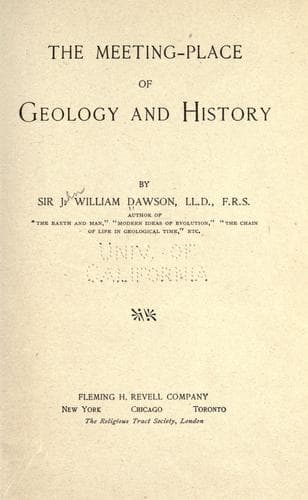
The Meeting-Place of Geology and HistoryDawson, John William, Sir
Religion
The Meeting-Place of Geology and History
Dawson, John William, Sir
Deluge; Prehistoric peoples
Pictet has estimated the number of species of mammals inhabiting
Europe in the palanthropic period at ninety-eight,[12] of which only
fifty-seven now live there, the remainder being either wholly or locally
extinct--that is, they are either not now existing in any part of the
world, or are found only beyond the limits of Central, Western, and
Southern Europe. The extinct species also include the largest and
noblest of all. It has been remarked that the assemblage of palanthropic
species in Europe and Western Asia is so great and varied that with our
present experience we can scarcely imagine them to have existed
contemporaneously in the same region. For example, the association of
species of elephant and rhinoceros, the musk-sheep, the reindeer, the
Cape hyena, and the hippopotamus seems to be incongruous.
[12] Zittel, in a recent paper (1893), gives 110 species of mammals in
the pleistocene and early modern. Of these about twenty of the largest
and most important are extinct.
Various theories have been proposed to remove the difficulty. Modern
analogies will allow us to believe in such astounding facts if we take
into account the probability of a warm climate, especially in summer,
along with a wooded state of the country providing much shelter, and
wide continental plains affording facilities for seasonal migrations.
There were no doubt also climatal changes in the course of the age,
which may have tended to the remarkable mixture of animal types in its
deposits. In connection with this there is now every reason to believe
that while, in its earlier part, the palanthropic age was distinguished
by a warm climate, in its later portion a colder and more inclement
atmosphere crept over the northern hemisphere. As an illustration of
this, it is known that in the earlier part of the period a noble species
of elephant named _Elephas antiquus_, and a rhinoceros (_R. Merkii_),
abounded in Europe; but as the age advanced these species disappeared,
and were replaced by the mammoth (_E. primigenius_) and the woolly
rhinoceros (_R. tichorhinus_), animals clothed like the musk-ox in dense
wool and hair, and evidently intended for a rigorous climate. With and
succeeding these last species, the reindeer becomes characteristic and
abundant. It is, as we shall see, a point of much importance in what may
be called the prehistoric history of man, that he was introduced in a
period of genial temperature as well as of wide continental extension,
and survived to find his physical environment gradually becoming less
favourable, and the age ending in that great cataclysm which swept so
many species of animals and tribes of men out of existence, and reduced
the dry land of our continents to its present comparatively limited
area.
Public-domain text, read in full here on John Shaqi.
Reviews
Reviews
No reviews yet
Be the first to share your thoughts on this work.
Join the Discussion
Join the discussion
Sign in to leave a comment or review.
Sign InorCreate an account