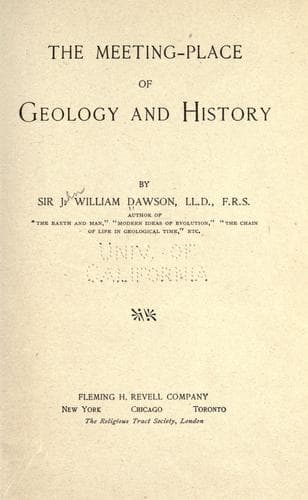
The Meeting-Place of Geology and HistoryDawson, John William, Sir
Religion
The Meeting-Place of Geology and History
Dawson, John William, Sir
Deluge; Prehistoric peoples
The science of the earth and the history of man, though cultivated by
very different classes of specialists and in very different ways, must
have their meeting-place. They must indeed not only meet, but overlap
and run abreast of each other throughout nearly the whole time occupied
by the existence of man on the earth. The geologist, from his point of
view, studies all the stratified crust of the earth, down to the mud
deposited by last year's river inundations. The historian, aided by the
archæologist, has written and monumental evidence carrying him back to
the time of the earliest known men, many thousands of years ago.
Throughout all this interval the two records must have run more or less
parallel to each other, and must be in contact along the whole line.
The geologist, ascending from the oldest and lowest portions of the
earth's crust, and dealing for millions of years with physical forces
and the instinctive powers of animals alone, at length as he approaches
the surface finds himself in contact with an entirely new agency, the
free-will and conscious action of man. It is true that at first the
effects of these are small, and the time in which they have been active
is insignificant in comparison with that occupied by previous geological
ages; but they introduce new questions which constantly grow in
importance, down to those later times in which human agency has so
profoundly affected the surface of the earth and its living inhabitants.
Finally, the geologist is obliged to have recourse to human observation
and testimony for his information respecting those modern causes to
which he has to appeal for the explanation of former changes, and has to
adduce effects produced by human agency in illustration of, or in
contrast with, mutations in the pre-human periods.
The historian, on the other hand, finds, as he passes backward into
earlier ages, documentary evidence failing him, and much of what he can
obtain becoming mythical, vague or uncertain, or difficult of
explanation by modern analogies, until at length he is fain to have
recourse to the pick-axe and spade, and to endeavour to disinter from
the earth the scanty relics of primeval man, much as the geologist
searches in the bedded rocks for the fossils which they contain. He has
even learned to use for these earliest ages the term prehistoric, and so
practically to transfer them to the domain of the archæologist and
geologist.
Public-domain text, read in full here on John Shaqi.
Reviews
Reviews
No reviews yet
Be the first to share your thoughts on this work.
Join the Discussion
Join the discussion
Sign in to leave a comment or review.
Sign InorCreate an account