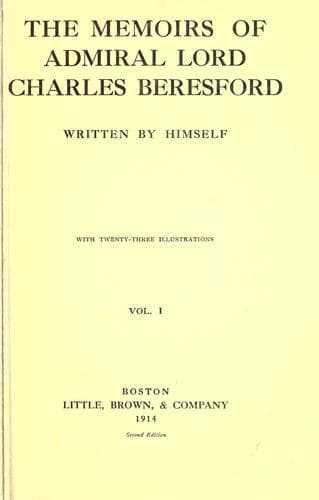
The Memoirs of Admiral Lord Beresford — John Shaqi
The Memoirs of Admiral Lord BeresfordBeresford, Charles William De la Poer Beresford, Baron
History
The Memoirs of Admiral Lord Beresford
Beresford, Charles William De la Poer Beresford, Baron
Admirals -- Great Britain -- Biography; Great Britain -- History, Naval -- 19th century
I was sent to sea for the somewhat vague reasons which so often
determine a boy's future. There was a belief that I was of a delicate
constitution, and an impression--perhaps justified--that I needed
discipline. I was sent to Bayford School in England when I was very
young, together with two of my three brothers. We were known as the
three "wild Irish." Among my schoolfellows were the present Lord
Rosebery, James Lowther, Lord Newport, Lord Claud Hamilton and Lord
George Hamilton, Lord Worcester, and Lord Methuen. From Bayford I went
to the educational establishment of the Rev. David Bruce Payne
(afterwards Canon) at Deal, where I first saw the ships of the Royal
Navy, as already related. Canon Payne was a splendid type of the best
British clergyman, and I had a great respect and affection for him. I
was afterwards a pupil of the Rev. Mr. Foster, of Stubbington, Fareham.
I received my nomination from Captain Charles Eden, C.B., and qualified
as a naval cadet on 12th December, 1859. The qualifying certificate
must be signed by the candidate; a regulation which, simple as it
seems, was nearly my undoing.
"Do you always sign your Christian name William with one 'l'?" asked
the examiner.
It was a critical moment. Irish resource supplied the answer.
I said, "Only sometimes, sir."
The examiner smiled grimly. But he passed me. It was my first narrow
escape in the Navy.
{6}
I have the faded blue paper before me as I write. The signature,
laboriously written in a round hand, is "Charles Wiliam Delapoer
Beresford."
The qualifying examination was not very formidable in those easy days.
The knowledge required consisted of a little "English," less French or
Latin (with the "aid of a dictionary"), a "satisfactory knowledge of
the leading facts of Scripture and English History," a certain amount
of geography, and an elementary knowledge of arithmetic, algebra and
Euclid. The preliminary course of education afforded to "Volunteers,"
as the naval cadets used to be called, at the Royal Naval College,
Portsmouth, had been abolished in 1837, and for the next twenty years
cadets were sent straight to sea. In 1857, cadets were entered for
training in the _Illustrious_, Captain Robert Harris. The number of
cadets exceeding the accommodation in the ship, the _Britannia_ was
commissioned on 1st January, 1859, by Captain Harris. But not for many
years did the entrance examination become the competitive ordeal for
which cramming is the only preparation, known to the present
generation. But I remember Admiral William Bowles, commander-in-chief
of Portsmouth, taking me kindly by the shoulder and saying, "Well, my
little man, you are very small for your age. Why are you being sent to
sea?"
I said that I wanted to go to sea.
"Are you good at your books?" asked the admiral. "Bless me, I know
many an admiral who could not pass the examination you have passed.
Good Heavens, what they expect boys to do nowadays!"
Public-domain text, read in full here on John Shaqi.
Reviews
Reviews
No reviews yet
Be the first to share your thoughts on this work.
Join the Discussion
Join the discussion
Sign in to leave a comment or review.
Sign InorCreate an account