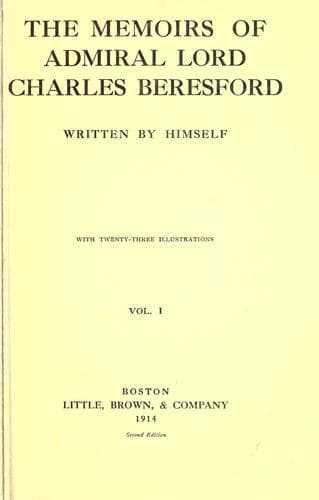
The Memoirs of Admiral Lord Beresford — John Shaqi
The Memoirs of Admiral Lord BeresfordBeresford, Charles William De la Poer Beresford, Baron
History
The Memoirs of Admiral Lord Beresford
Beresford, Charles William De la Poer Beresford, Baron
Admirals -- Great Britain -- Biography; Great Britain -- History, Naval -- 19th century
When I entered the Service, the system of training {9} young seamen, as
well as cadets, was in operation. To Sir James Graham, First Lord of
the Admiralty, is due the credit of introducing the training of seamen.
In 1854, he caused the _Illustrious_, two-decker, to be commissioned
for that purpose, under the command of Captain Robert Harris. The fact
was that as sails gave place to steam and as the science of gunnery
progressed, it became necessary to enter seamen as boys and to train
them for continuous service. For some time the short service and long
service systems were concurrent. When I went to sea, captains still
entered men direct from the merchant service, and very good seamen they
were. They were engaged for a commission, at the end of which they
could re-engage or not as they pleased. But in the meantime, under the
admirable administration of Captain Harris, "Jimmy Graham's novices,"
as they were called, earned an excellent reputation in the Fleet; and
continuous service gradually replaced intermittent service. In the
continuous service system resided our chief superiority over foreign
Navies. The objection to it on the part of the Government was (and is)
the increasing permanent charge of pensions. But in the interests of
the Service and of the country, it cannot be too clearly understood
that the system is well worth the cost, and that the revival of the
short service system is profoundly to be regretted.
NOTE
H.M.S. _Britannia_.--She was the seventh ship of her name. She was
launched at Plymouth in 1820, was pierced for 120 guns, and her
complement was 900 men. Her length, beam and draught were 205 feet, 53
feet and 18 feet respectively. In the Crimean war, she landed 200 men
as part of the naval brigade which assisted the Army at the siege of
Sevastopol, and took part in the bombardment of that town. She was
commissioned on 1st January, 1859, by Captain Robert Harris, as a
training ship for cadets. {10} The _Britannia_ was stationed first in
Portsmouth Harbour, then at Dartmouth. She was broken up in 1869. The
memory of Captain Robert Harris deserves to be held in high honour.
Vice-Admiral Sir William Fanshawe Martin, who himself achieved great
reforms in the discipline of the Fleet, while in command of the
Mediterranean Fleet, wrote to Captain Harris under date 18th January,
1861, "There is no man in England whose opportunity of doing good to
our country for ages to come is greater than yours; and assuredly the
Navy is greatly your debtor." (_The Story of the Britannia_, by
Commander E. P. Statham, R.N. Cassell.)
The successor of the _Britannia_ in which Lord Charles Beresford
received his training, the eighth of her name, known and remembered
with affection by all naval officers save the new generation, lay at
Dartmouth for more than forty years, when her functions were
transferred to the colleges on shore. (_The King's Ships_, by H. S.
Lecky, Lieut. R. N. Muirhead. Vol. 1.)
{11}
CHAPTER III
Public-domain text, read in full here on John Shaqi.
Reviews
Reviews
No reviews yet
Be the first to share your thoughts on this work.
Join the Discussion
Join the discussion
Sign in to leave a comment or review.
Sign InorCreate an account