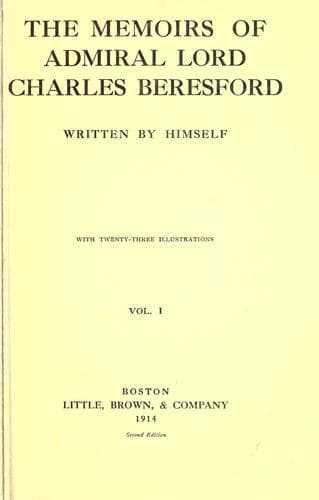
The Memoirs of Admiral Lord Beresford — John Shaqi
The Memoirs of Admiral Lord BeresfordBeresford, Charles William De la Poer Beresford, Baron
History
The Memoirs of Admiral Lord Beresford
Beresford, Charles William De la Poer Beresford, Baron
Admirals -- Great Britain -- Biography; Great Britain -- History, Naval -- 19th century
THE SHIP OF HAPPIEST MEMORY
On the 25th of March, 1861, I was appointed naval cadet in the
_Marlborough_. As I climbed up her side by the hand-rungs, while my
chest was being hoisted in over all, I perceived two huge men looking
down upon me, and I heard one say to the other:--
"That white-faced little beggar ain't long for this world, Dick."
The speaker was John Glanville (called Clamfy Glanville), boatswain's
mate (of whom more anon), and he addressed this lugubrious remark to
Dicky Horne, the quartermaster, a very fat man. It was a far from
encouraging welcome to the sea; but the fact was that I had been ill,
and was feeling very cold as I climbed up the side of the ship. At
first, I was much disappointed at having been sent to a large ship, for
we youngsters had a notion that there were more freedom and
independence in a small ship; and besides, I wanted to go to China.
But I went to China all in good time.
The _Marlborough_ was the flagship of the Mediterranean station. She
was a wooden line of battleship, three-decker, launched in 1835, 4000
tons burthen old measure, 6390 displacement new measure, fitted with
single screw horizontal Maudslay engines. The length of her gundeck
was 245 feet 6 inches, her extreme beam was 61 feet, her maximum
draught was 26 feet. Her complement was 950, and she always carried
100 or more supernumeraries. She was pierced for 131 guns and she
carried 121 guns. She was {12} one of the first ships to be fitted
with wire lower rigging. In the _Marlborough_ the old 24-inch hemp
cable was used for laying out anchor at drill. It was the same class
of cable as that which was used in Nelson's time; it was superseded by
the chain cable.
The vice-admiral in command of the Mediterranean station was Sir
William Fanshawe Martin (called "Fly" Martin); the captain, William H.
Stewart; the commander, Thomas Brandreth: three of the finest officers
that ever lived. The captain of the Fleet was Rear-Admiral Sydney C.
Dacres, C.B. His duties were those of what we should now call a chief
of staff. The office was subsequently abolished; and it was always my
desire to see it restored.
Public-domain text, read in full here on John Shaqi.
Reviews
Reviews
No reviews yet
Be the first to share your thoughts on this work.
Join the Discussion
Join the discussion
Sign in to leave a comment or review.
Sign InorCreate an account