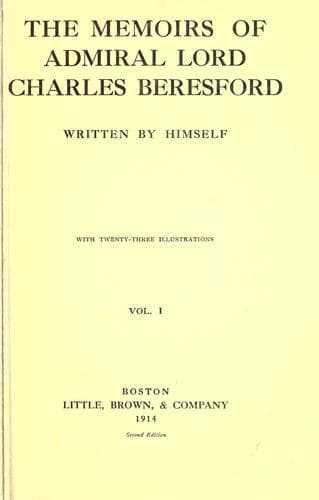
The Memoirs of Admiral Lord BeresfordBeresford, Charles William De la Poer Beresford, Baron
History
The Memoirs of Admiral Lord Beresford
Beresford, Charles William De la Poer Beresford, Baron
Admirals -- Great Britain -- Biography; Great Britain -- History, Naval -- 19th century
"3. If not, should not immediate steps be taken to minimise the danger?"
The Memorandum was laid before the Board. My colleagues came to the
unanimous conclusion that my statements were exaggerated; and also
that, as a junior, I was {347} meddling with high matters which were
not my business; as indeed I was. Having been thus defeated, I asked
the permission of Lord George Hamilton to show the Memorandum to Lord
Salisbury, and received it.
Lord Salisbury very kindly read the document then and there from
beginning to end. He pointed out to me that, on the face of it, I
lacked the experience required to give force to my representations, and
that I had not even commanded a ship of war in a Fleet.
"You must have more experience, on the face of it," he repeated.
And he observed that, practically, what I was asking him to do, was to
set my opinion above the opinion of my senior officers at the
Admiralty, and their predecessors.
I replied that, since he put the matter in that way, although it might
sound egotistical, I did ask him to do that very thing; but I begged
him, before deciding that I was in the wrong, to consult with three
admirals, whom I named.
A week later, I saw Lord Salisbury again. He told me that in my main
contentions, I was right; that he was sure I should be glad to hear
that the three admirals had agreed with them; and that the Board of
Admiralty had decided to form a new department upon the lines I had
suggested.
The new Naval Intelligence Department was then formed.
The Director was Captain William H. Hall. His assistants were Captain
R. N. Custance (now Admiral Sir Reginald N. Custance, K.C.B., K.C.M.G.)
and Captain S. M. Eardley-Wilmot (now Rear-Admiral Sir S. M.
Eardley-Wilmot).
There was already in existence a Foreign Intelligence Committee, whose
business it was to collect information concerning the activities of
foreign naval Powers. In my scheme the new department was an extension
of the Foreign Intelligence Committee, which was to form Section 1,
while {348} the duties of Section 2 were "To organise war preparations,
including naval mobilisation and the making out of plans for naval
campaigns to meet all the contingencies considered probable in a war
with different countries, corrected frequently and periodically." The
whole of the department was to be placed under an officer of flag rank;
a part of my recommendations which was not carried into effect until
1912, when the War Staff was instituted at the Admiralty.
It will be observed that, although I designated the new department the
Intelligence Department, it was in fact planned to combine Intelligence
duties proper with the duties of a War Staff. What I desired was a
department which reported "frequently and periodically" upon
requirements. But as it was impossible to know what those requirements
would be without plans of campaign which specified them, the same
department was charged with the duty of designing such plans.
Public-domain text, read in full here on John Shaqi.
Reviews
Reviews
No reviews yet
Be the first to share your thoughts on this work.
Elsewhere in the archive
Join the Discussion
Join the discussion
Sign in to leave a comment or review.
Sign InorCreate an account