Cramp, Charles Henry, 1828-1913; Naval architects -- United States -- Biography
E-text prepared by deaurider, Barry Abrahamsen, and the Online Distributed
Proofreading Team (http://www.pgdp.net) from page images generously made
available by Internet Archive (https://archive.org)
Note: Project Gutenberg also has an HTML version of this
file which includes the original illustrations.
See 57081-h.htm or 57081-h.zip:
(http://www.gutenberg.org/files/57081/57081-h/57081-h.htm)
or
(http://www.gutenberg.org/files/57081/57081-h.zip)
Images of the original pages are available through
Internet Archive. See
https://archive.org/details/cu31924024551156
Transcriber’s note:
Text that was in italics is enclosed by underscores (_italics_).
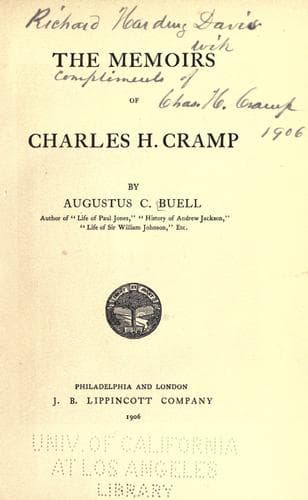
THE MEMOIRS OF CHARLES H. CRAMP
[Illustration: CHARLES H. CRAMP]
THE MEMOIRS OF CHARLES H. CRAMP
by
AUGUSTUS C. BUELL
Author of “Life of Paul Jones,” “History of Andrew Jackson,”
“Life of Sir William Johnson,” Etc.
[Illustration: Publisher’s Logo]
Philadelphia and London
J. B. Lippincott Company
1906
Copyright, 1906
By J. B. Lippincott Company
Printed by J. B. Lippincott Company, Philadelphia
------------------------------------------------------------------------
PREFACE
❦
IT is not often that the memoirs of a man cover the history of
threescore years of active manhood. Still more rare is it that the
period covered happens to be the most fruitful of progress known in the
annals of mankind. And yet more remarkable, even to the point of the
unique, is it that such a career, in such an epoch, should be
inextricably interwoven with the history of one of the fairest arts and
one of the most fascinating sciences,—Naval Architecture and
Ship-building.
All this is true of the subject of this memoir, Charles Henry Cramp.
Such phrases as “prominently identified with” or “an acknowledged leader
in” his sphere of creative activity do not adequately express Charles H.
Cramp’s personal and professional relation, or rather his individual
identification, with the maritime and naval history of his country.
Those phrases applied to his status and his rank would be commonplace.
His impress is far deeper than that, and the association of his name and
his personality with the art and its triumphs have become a symbol.
Public-domain text, read in full here on John Shaqi.
Reviews
Reviews
No reviews yet
Be the first to share your thoughts on this work.
Join the Discussion
Join the discussion
Sign in to leave a comment or review.
Sign InorCreate an account