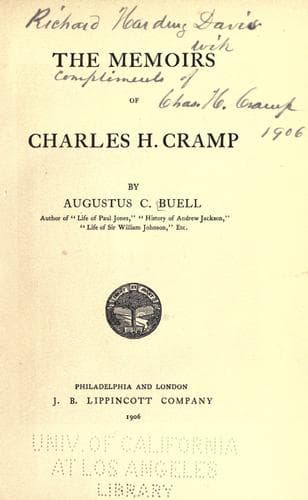
Cramp, Charles Henry, 1828-1913; Naval architects -- United States -- Biography
From 1775 till the peace of 1783, Philadelphia yards built a great
number of privateers and converted a few ships for the “State Navy,” as
it was called, that is to say, ships provided by the Commonwealth of
Pennsylvania and assigned to the Continental service. One of these, a
converted bark of two hundred tons and mounting sixteen 6-pounders, has
passed into fame as the “Hyder Ali.” Under Lieutenant Joshua Barney she
took the “General Monk,” a regular sloop-of-war, mounting fourteen
9-pounders and four 6-pounders. The “Hyder Ali” was a small French bark
which arrived at Philadelphia with military supplies early in February,
1782. She was at once bought by the State and placed in Humphrey’s yard
for conversion into a cruiser. Within six weeks she was put in
commission, and she took the “General Monk,” April 8, about two months
after her arrival in port as a merchant vessel. This was the last
capture of an English man-of-war in the Revolution.
The peace of 1783 found Philadelphia possessing only thirteen merchant
vessels, all built before the war and nearly all of which had served as
privateers during the conflict. No new merchant keel had been laid in a
Philadelphia yard between 1775 and 1782; but the industry revived with
wonderful energy. From 1782 to 1787, one hundred and fifty-five vessels
were built, of which fifty-six were square-rigged ships averaging over
three hundred tons. From this period on the progress was very great. The
outbreak of the wars of the French Revolution in 1793 at once threw a
vast carrying trade into American bottoms, the United States being for a
long time the only neutral maritime nation. By the year 1801, when the
treaty, or truce, of Amiens was signed, nearly three hundred sea-going
ships were owned in Philadelphia, all home-built, and fourteen shipyards
were in operation,—eight in the northern or Kensington and six in the
southern or Southwark district. These were all first-class shipyards,
building the largest full-rigged ships of that epoch. In that period and
for a long time afterward the leading Philadelphia shipyard was that of
Joshua Humphreys, in Southwark, and its proprietor and manager was
himself the foremost naval architect of his time. When Congress, in
1794, authorized the construction of six frigates, and thereby laid the
foundation of what we call the modern or “regular” navy, as
distinguished from the old Continental navy of the Revolution, prominent
ship-builders were asked to submit plans, the government then having no
naval constructors. The plans of Mr. Humphreys were adopted for all six
frigates. Three of them embodied a distinct advance in size and weight
of armament over vessels of similar rate in other navies, and were
classed as 44-gun frigates. The other three were designed as 38-gun
frigates, and were an improvement upon the 36-gun ships of European
navies. These six ships were built by contract,—one of the forty-fours
Public-domain text, read in full here on John Shaqi.
Reviews
Reviews
No reviews yet
Be the first to share your thoughts on this work.
Join the Discussion
Join the discussion
Sign in to leave a comment or review.
Sign InorCreate an account