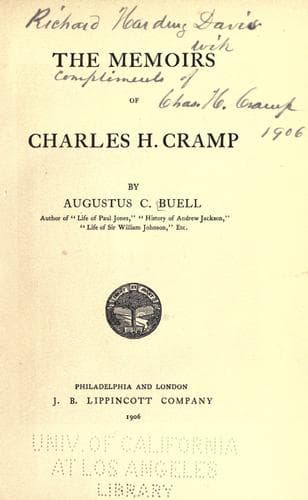
Cramp, Charles Henry, 1828-1913; Naval architects -- United States -- Biography
In those early days the population kept within easy reach of the coast
or of the arms of the sea and estuaries which abound from the Savannah
on the south to the Penobscot on the north. The back country, forming
the eastern or Atlantic slope of the Appalachian chain, was little more
than a hunting and trapping ground or a field for primitive trade and
barter with the Indians. As for the vast “hinterland,” west of the
Alleghenies, it was, up to the middle of the eighteenth century, when
the final struggle between England and France for supremacy on this
continent began, an unbroken wilderness, inhabited only by hostile
savages, and unknown to any white men except the Jesuit priests and the
cunning traders of French Canada.
For all these reasons, the gaze of the English-speaking colonists from
the earliest settlements to the beginning of the conquest of Canada was
always bent toward the sea, and all their enterprise and energy were
directed to the commerce of the ocean. Under such conditions, the
development of skill in ship-building was inevitable; and with that
necessity was also bred a scientific alertness in marine architecture
itself which, as soon as political independence freed its scope, became
supreme throughout the civilized world.
The outbreak of the Revolution of course, for the time being, put an end
to merchant ship-building in all American ports. But in Philadelphia the
paralysis was only temporary, and the energies heretofore directed
toward construction of ships for the uses of peace were soon turned to
the conversion of available merchantmen into vessels of war or
privateers, and the building of new frigates ordered by Congress. The
first American squadron, that of the ill-starred Commodore Esek Hopkins,
was composed entirely of merchant vessels taken up in the harbor and
converted into men-of-war in the shipyards of Philadelphia during the
autumn of 1775.
It was in the selection and conversion of these four merchantmen into
cruisers that Paul Jones, founder of the American navy, first gave to
the United States his energies and his talents. Thus Philadelphia was
the birthplace of a new sea-power, and her shipyards have ever since
been the foremost contributors to its growth, until even now, though
only a century and a quarter old, it has achieved imperial rank.
In November, 1775, Congress authorized the construction of six 32-gun
frigates and seven other war vessels of less dimensions. Four of the
frigates were allotted to Philadelphia shipyards. They were the
“Washington,” the “Randolph,” the “Delaware,” and the “Effingham.” The
first two were frigate-built from their keels, but the “Delaware” and
“Effingham,” to save time, were built upon frames already on the stocks
for merchant ships when the war began. On this account they were not
quite as large as the regular frigates and rated twenty-eight instead of
thirty-two guns.
Public-domain text, read in full here on John Shaqi.
Reviews
Reviews
No reviews yet
Be the first to share your thoughts on this work.
Join the Discussion
Join the discussion
Sign in to leave a comment or review.
Sign InorCreate an account