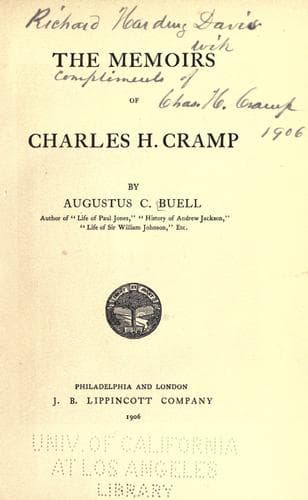
Cramp, Charles Henry, 1828-1913; Naval architects -- United States -- Biography
During these operations the show of secrecy was maintained, but Captain
Gore-Jones still zealously endeavored to keep himself and his government
_au courant_ with everything that was going on. In pursuit of this duty,
he managed on one occasion to get into the shipyard in the disguise of a
workman and on the pass or ticket which was then issued for the
admission of workingmen. He was, however, soon observed by Captain
Avalan of the “Asia,” who at once reported the fact of his presence to
the office. Captain Gore-Jones was then politely but firmly ushered out
of the shipyard and requested not to enter it again.
[Illustration: AMERICAN LINER ST. PAUL]
This incident of Captain Gore-Jones’s futile attempt to play detective
attracted wide attention and much comment. Among the newspaper articles
on that subject was one in the columns of the Washington _Sunday
Capital_, a journal then having national reputation for wit and humor.
The material part of it was as follows:
“Among the ornaments of the Diplomatic Corps is a possible, though
not altogether probable, successor of Nelson. He appears in the
Congressional Directory as Captain Gore-Jones, Naval Attaché of H.
B. M. Legation. Neither one of his two names, viewed separately,
suggest aristocracy. Both viewed together in normal condition are
not calculated to excite suspicion of blue blood. Still, Gore-Jones
is an aristocrat. The hyphen is what does it. For the rest,
Gore-Jones, being an English naval officer, is a Welshman born in
Ireland.
“His duties are supposed to be the observing of things naval in this
country. Being unable to discover a navy, or anything resembling
one, in possession of the United States, it occurred to him that
perhaps he might find here a navy or part of one belonging to some
other power. In fact, it was rumored in the Corps Diplomatique that
Gore-Jones had been notified that he must either find a navy in this
country somewhere and belonging to somebody or lose his job.
Naturally, his first quest would be at our navy-yards (so-called),
but at none of these could he even detect symptoms of naval
intention. All he could find was a few old hawse-holes. He was
informed that these had been accumulated by that jolly old tar, the
rotund Robeson, with the intention of building wooden tubs around
them whenever Grant might happen to run for a third term. He was
also informed that the present reform administration of the
venerable Richard W. Thompson, of Indiana, viewed these hawse-holes
with suspicion. This was because they were hollow; whereas the
venerable reformer believed that everything about a ship should be
solid.
Public-domain text, read in full here on John Shaqi.
Reviews
Reviews
No reviews yet
Be the first to share your thoughts on this work.
Elsewhere in the archive
Join the Discussion
Join the discussion
Sign in to leave a comment or review.
Sign InorCreate an account