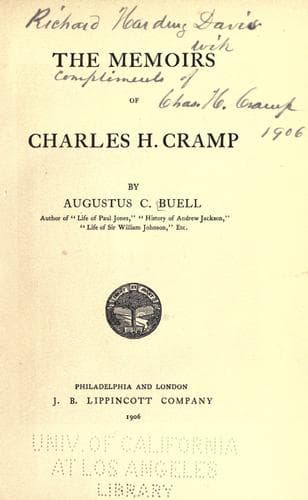
Cramp, Charles Henry, 1828-1913; Naval architects -- United States -- Biography
The renewal of general war in Europe in 1803 gave a fresh impetus to the
neutral carrying trade of the United States, and with it a corresponding
stimulus to ship-building all along the coast, though most pronounced
and on a larger scale at Philadelphia than elsewhere. Between the above
date and 1812 nine more shipyards were established, making twenty-three
all told in operation at one time. The largest merchant vessel up to
that time built in America was one of seven hundred and five tons,
constructed by Samuel Bowers for the East India trade, and her
dimensions were not exceeded in merchant construction until after the
War of 1812-15. Her contract price was $24,000; at the rate of $34 per
ton gross measurement. At that time vessels of similar class cost ten
guineas ($50) per gross ton in British shipyards.
In a public document on the statistics of ship-building, we find a
statement that “in June, 1787, the ship ‘Alliance,’ owned by Robert
Morris and commanded by Captain Thomas Read, sailed from Philadelphia
for Canton and Batavia. She was of seven hundred tons burthen, and the
largest ship built for commerce in America at that time.”
The statement that the “Alliance” was “built for commerce” is an error.
She was the famous old Revolutionary frigate which Paul Jones and John
Barry had commanded at different times. After the peace of 1783 she was
sold to Mr. Morris, or rather turned over to him in part payment for
advance he had made to the Continental government. She was converted
into a merchant ship and made several China voyages. The government then
bought her back again in 1790, but she was not refitted as a war vessel.
During the general period under consideration, that is to say, from the
end of the Revolution to the beginning of the War of 1812, a new and
highly important deep-sea traffic came into existence, of which
Philadelphia soon obtained the supreme command. This was the East India
and China trade. The first vessel to clear from Philadelphia for China
direct was the new ship “Canton,” built by Humphreys and commanded by
Captain, afterward Commodore, Thomas Truxtun.
This was the same Thomas Truxtun who, during the Revolution, had seen
more service in privateers than any other sailor then afloat. He served
either as mate or commander in the Philadelphia privateers, “Andrew
Caldwell,” “Congress,” “Independence,” “Mars,” and “St. James,” from
1775 to 1782. His ships made altogether sixty-five captures of British
merchantmen and transports. While commanding the “St. James,” of twenty
guns, in 1781, he beat off and disabled a British 28-gun frigate. After
the Revolution he commanded Philadelphia Indiamen from 1785 to 1798,
when he was commissioned one of the original six captains in the regular
navy. In the short war with France in 1799 he commanded the
“Constellation,” 38-gun frigate, and took the French frigate
“l’Insurgente,” of forty guns.
Public-domain text, read in full here on John Shaqi.
Reviews
Reviews
No reviews yet
Be the first to share your thoughts on this work.
Join the Discussion
Join the discussion
Sign in to leave a comment or review.
Sign InorCreate an account