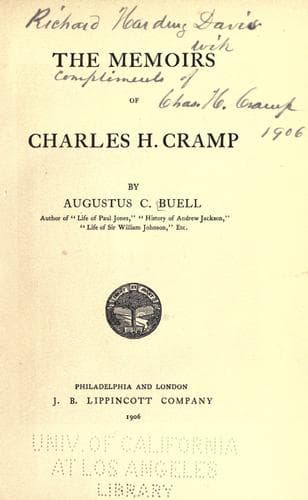
Cramp, Charles Henry, 1828-1913; Naval architects -- United States -- Biography
The “Canton” sailed from Philadelphia on December 30, 1785. She returned
in May, 1787, having made the round voyage to Canton, Batavia, and home
in a little over sixteen months. Her venture was highly profitable. From
this beginning the far eastern trade grew steadily until, in 1805,
Philadelphia alone owned twenty-seven ships plying in it, ranging from
four hundred and twenty to seven hundred and five tons. Between 1805 and
1812, inclusive, the number of Philadelphia Indiamen and China ships
increased to forty-two, notwithstanding the injurious effect of
President Jefferson’s ill-advised embargo. In fact, that measure was not
much observed by ship-owners in the India and China trade. President
Jefferson did not attempt to enforce his embargo by either civil or
military power, and very soon after he proclaimed it, the understanding
became general among merchant ship-owners that if they chose to take the
risks entailed by the British “Orders in Council” and Napoleon’s
“Decrees of Milan and Berlin,” they could do so at their peril, with no
recourse for protection or indemnity in case of misfortune. Under these
conditions, ship-owning merchants, in other coast cities who traded with
European or West India ports, for the most part hesitated to take the
chances. But the Philadelphia merchant princes, who controlled the
American trade with the British and Dutch East Indies and China, were
not so easily foiled. They loaded and despatched their ships during the
embargo, a period of nearly two years, almost as freely, if not as
ostentatiously, then as they had done before or as they did afterward.
This policy was founded upon the soundest judgment. The India and China
merchants of Philadelphia understood perfectly that the titanic struggle
between England and Napoleon involved conflicting policies and ambitions
relating only to the commerce between America and Europe, not to that
between America and the Orient. Occasionally an American ship bound for
India or China or thence for home would be brought to by an English or a
French cruiser and searched. But, as those ships never carried anything
contraband of war, the worst that ever happened to them was the
occasional impressment of parts of their crews by the English or the
levying of a small tribute by the French. The voyages, as a whole, were
seldom interrupted, and almost never terminated by detention or capture.
These were the halcyon days of Philadelphia’s trade with the far East.
From 1803 to 1815 the French could not trade to the Orient at all. And
though the East India Company kept up the sailings of its fleet with
more or less regularity, yet the war rates of insurance and the expense
and inconvenience of constant convoy placed their traffic at signal
disadvantage as compared with that of the neutral Americans.
Public-domain text, read in full here on John Shaqi.
Reviews
Reviews
No reviews yet
Be the first to share your thoughts on this work.
Join the Discussion
Join the discussion
Sign in to leave a comment or review.
Sign InorCreate an account