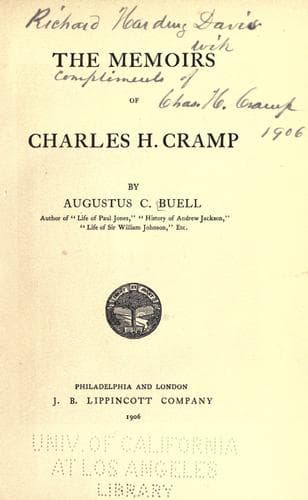
Cramp, Charles Henry, 1828-1913; Naval architects -- United States -- Biography
In his operations at St. Petersburg leading up to these important
contracts, which aggregated nearly seven millions of dollars, including
extra work ordered during construction, Mr. Cramp encountered powerful
and persistent opposition from three widely diverse sources. First,
there was an element strongly intrenched in the Ministry of Marine, who
opposed the award of contracts to foreign builders other than the
French. This element of opposition was powerfully represented on the
Technical Board, and its influences were shown particularly in the
Ordnance installation and in the Engineering section, who wanted
everything done in Russia. It proved factious and troublesome, though
not otherwise formidable, because the decision to have some of the ships
in the programme of 1898 built abroad had already been reached in higher
quarters. In fact, though not definitely so announced by the Russian
government, it was known by the middle of March, 1898, at least by those
intending to bid, that the Ministry of Marine had decided to award
contracts for the construction of two first-class battle-ships, one
armored cruiser, and three first-class protected cruisers of the highest
speed in foreign shipyards, and a large number of torpedo boats.
The French and German shipyards were represented not only by their own
agents and experts, but they were backed, and their claims to
consideration urged, with all the power and influence their respective
Embassies and banking houses could command at the Court of St.
Petersburg.
However, this situation was not at all unforeseen or unexpected by Mr.
Cramp. To encounter opposition from the agents of the foreign banking
houses and diplomats was a normal condition of this kind of business.
Fortunately for Mr. Cramp, or, rather, fortunately for American
industrial interests at large, we also had an ambassador at St.
Petersburg in 1898. He was not of the common run of American diplomatic
representatives “near” foreign Courts. He was different. Almost from the
foundation of our government, a rule—amounting to unwritten law—had
prevailed which forbade American diplomatic representatives abroad to do
or say anything in aid or furtherance of commercial or industrial
enterprises of American citizens in the country to which they were
accredited.
Public-domain text, read in full here on John Shaqi.
Reviews
Reviews
No reviews yet
Be the first to share your thoughts on this work.
Elsewhere in the archive
Join the Discussion
Join the discussion
Sign in to leave a comment or review.
Sign InorCreate an account