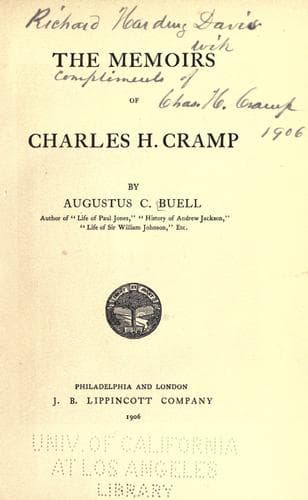
Cramp, Charles Henry, 1828-1913; Naval architects -- United States -- Biography
Object lessons were before them. During Polk’s Administration, James
Buchanan, then Secretary of State, had removed, or rather transferred to
another post, a United States Minister to one of the South American
Republics on the Pacific slope. This Minister had committed the, in
United States “diplomacy,” unpardonable offence of indorsing the drafts
of certain whale-ship captains upon their owners in New Bedford and
Nantucket. The ships of these captains were in distress, having been
dismasted in tempestuous passages around Cape Horn, and they had made
their voyage to Valparaiso under jury-masts. Arrived there, they needed
money to repair and refit their battered and storm-beaten ships. Our
Minister to Chile used his good offices to help them get their drafts
cashed so they could repair their vessels and pursue their voyages.
This, from the view-point of primitive United States “diplomacy,” was of
course a crime, and the Minister was made to suffer for it! Ultimately
this unwritten law or tacit doctrine found expression on the floor of
the Senate, in a debate on the Consular and Diplomatic Appropriation,
from the lips of Thomas F. Bayard:
“The purity and dignity of our foreign representation,” he said,
“must be preserved! The law now recognized, though unwritten, should
be made statutory! If an American Minister abroad should use any of
the influence or employ any of the prestige or credit which he may
derive from his status as a representative of this country to aid or
further or promote any scheme or project of American citizens in
that country, having private gain in view, he should be held
answerable for official misdemeanor!”
Buchanan and Bayard have already found their proper levels in American
history, and need not be discussed here, even if their memories were
worth discussion. But the theory they applied to our diplomatic
representation was for many years the rule. The result was that our
“diplomatic service” (so-called) down to, we may say, the end of
Cleveland’s last Administration, had become little else than a hospital
for political cripples, or a sanitarium for over-worked old lawyers and
nervously prostrated college professors. It was the laughing-stock of
foreigners and the object of cynical, albeit good-natured, contempt on
the part of our own people. It had become a symposium of urbane
uselessness and solemn stupidity.
All this was changed in our representation at St. Petersburg in 1898.
Our Ambassador there was the Hon. Ethan Allen Hitchcock, of Missouri. He
was neither a political cripple, nor an overworked old lawyer, nor a
college president needing a gilt-edged vacation.
Public-domain text, read in full here on John Shaqi.
Reviews
Reviews
No reviews yet
Be the first to share your thoughts on this work.
Elsewhere in the archive
Join the Discussion
Join the discussion
Sign in to leave a comment or review.
Sign InorCreate an account